x
INTEGRITY
│
Advocates
•
Solicitors
•
Mediators
•
Chartered Accountants
•
Insolvency Professionals
Advocates & Solicitors

Chapter 3 – Rights and Duties of Promoters
The promoter occupies a central position under the Real Estate (Regulation and Development) Act, 2016. RERA imposes extensive statutory obligations upon promoters to ensure transparency, financial discipline and timely completion of projects while simultaneously conferring certain rights necessary for efficient execution and management of the development.
Practice Note
Most disputes before the Real Estate Regulatory Authority arise from alleged non-compliance with the statutory obligations of promoters. A clear understanding of these duties is therefore essential for developers, homebuyers and legal practitioners alike.
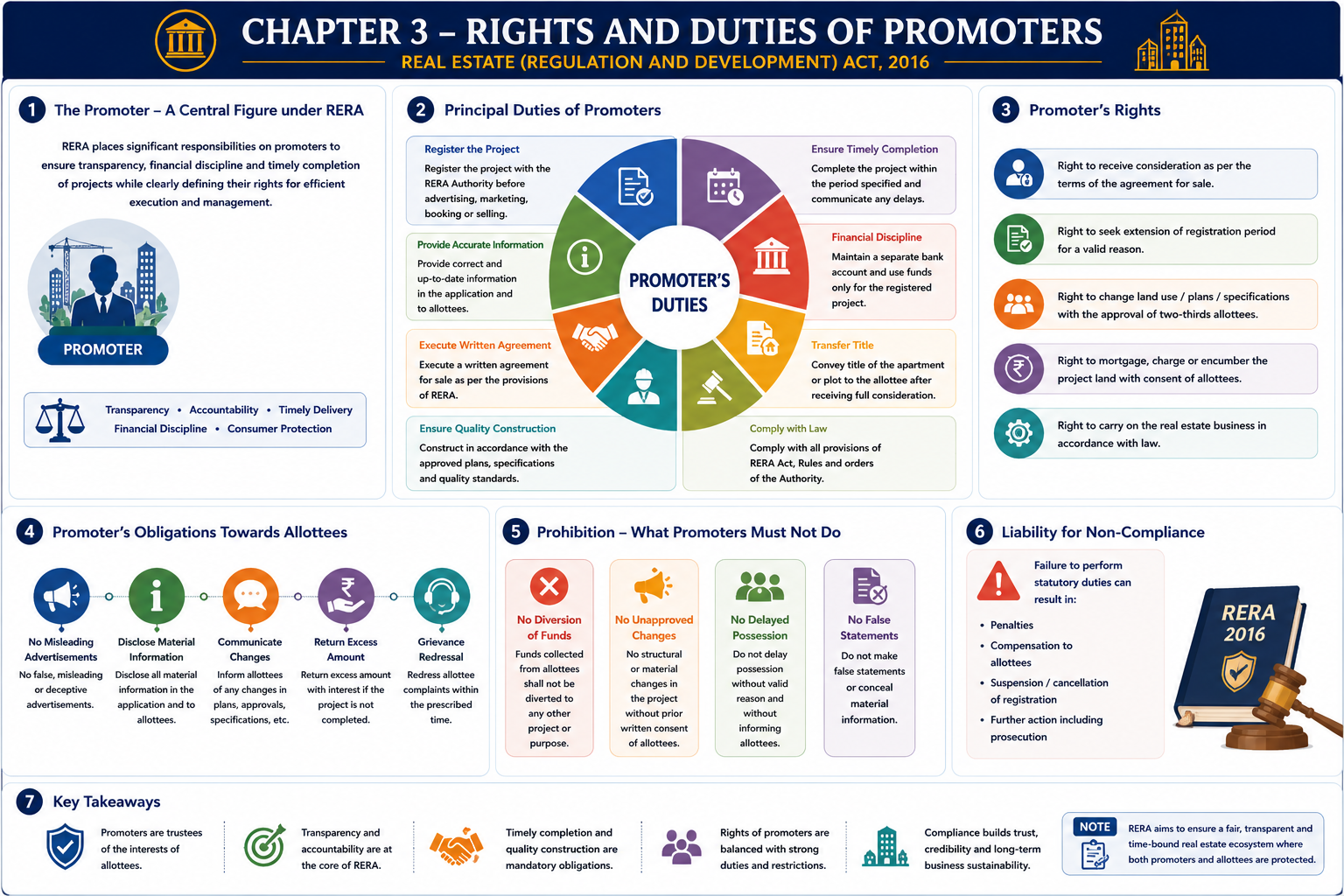
Principal Duties of Promoters
| Duty | Purpose |
|---|---|
| Register the Project | Ensure regulatory supervision before marketing or sale. |
| Make True Disclosures | Provide complete and accurate information regarding approvals, title, layout plans and project details. |
| Maintain Separate Bank Account | Ensure proper utilisation of funds collected from allottees. |
| Complete the Project on Time | Deliver possession within the agreed timeline. |
| Rectify Structural Defects | Rectify structural defects and defects in workmanship, quality or services within the statutory defect liability period. |
| Execute Conveyance Deed | Transfer legal title to the allottee or the association of allottees after completion of the project. |
| Comply with Approved Plans | Develop the project strictly in accordance with the sanctioned plans and statutory approvals. |
Statutory Duties under RERA
Sections 11 to 18 of RERA prescribe the principal obligations of promoters. These provisions ensure transparency, accountability and timely completion of projects while safeguarding the interests of allottees.
| Section | Subject Matter |
|---|---|
| Section 11 | Functions and duties of promoters. |
| Section 12 | Liability for false or misleading advertisement. |
| Section 13 | Execution of Agreement for Sale. |
| Section 14 | Adherence to sanctioned plans and project specifications. |
| Section 15 | Transfer of promoter's rights and obligations. |
| Section 16 | Insurance of land and building. |
| Section 17 | Transfer of title and handing over documents. |
| Section 18 | Return of amount, interest and compensation. |
Liability for False Advertisement
A promoter is responsible for the accuracy of all advertisements, prospectuses and representations made to prospective purchasers. Any person who suffers loss due to a false or misleading statement may seek compensation under Section 12 of the Act.
Practice Note
Brochures, websites, social media advertisements and marketing material frequently become important evidence in RERA proceedings. Promoters should ensure that every representation accurately reflects the approved plans and statutory approvals.
Transfer of Project to Another Promoter
Section 15 of RERA prohibits a promoter from transferring or assigning the majority rights and liabilities in a real estate project to a third party without obtaining the prior written consent of at least two-thirds of the allottees (excluding the promoter's own holdings) and the prior written approval of the Real Estate Regulatory Authority. This safeguard protects homebuyers from unilateral changes in project management.
Insurance and Transfer of Title
Promoters are required to obtain insurance, wherever applicable, in respect of land title, buildings and construction. Upon completion of the project, the promoter must execute the registered conveyance deed in favour of the allottee or the association of allottees and hand over all relevant documents and plans in accordance with Sections 16 and 17 of the Act.
Consequences of Non-Compliance
| Default | Possible Consequence |
|---|---|
| False Advertisement | Compensation to affected allottees and other action under the Act. |
| Delay in Possession | Liability to refund the amount received with interest or pay interest for the period of delay, subject to the provisions of the Act. |
| Violation of Approved Plans | Directions from the Regulatory Authority, rectification and other statutory consequences. |
| Breach of Statutory Duties | Penalty, compensation or other action as provided under RERA. |
State Practice Note
Although the Real Estate (Regulation and Development) Act, 2016 is a Central legislation, each State has framed its own Rules and administrative procedures. Practitioners should therefore verify the applicable State Rules, notifications and the latest directions issued by the concerned State Real Estate Regulatory Authority before advising clients.
Practical Checklist for Advocates
✓ Verify
Project registration, approvals and title documents.
✓ Examine
Agreement for Sale and disclosure documents.
✓ Check
Whether statutory timelines and obligations have been complied with.
✓ Collect
Advertisements, brochures, emails and project communications as documentary evidence.
Relevant Provisions
| Provision | Subject |
|---|---|
| Sections 11–18 | Rights and Duties of Promoters. |
| Section 12 | False Advertisement. |
| Section 14 | Adherence to Sanctioned Plans. |
| Section 15 | Transfer of Project. |
| Sections 16–17 | Insurance and Transfer of Title. |
| Section 18 | Refund, Interest and Compensation. |
AVP Practice Tip
In disputes involving delayed possession or construction deficiencies, advocates should obtain the RERA registration details, sanctioned plans, Agreement for Sale, payment records, correspondence, brochures and quarterly project updates. These documents often determine the outcome of proceedings before the Regulatory Authority and the Appellate Tribunal.
Key Takeaways
- Promoters are subject to extensive statutory obligations under Sections 11–18 of RERA.
- Transparency and timely completion form the foundation of promoter compliance.
- False advertisements and misleading representations may result in compensation and regulatory action.
- Transfer of projects requires statutory approvals and protection of allottees' interests.
- Proper documentation is essential for both compliance and dispute resolution.
Statutory Duties under RERA
Sections 11 to 18 of the Real Estate (Regulation and Development) Act, 2016 prescribe the principal obligations of promoters. These provisions ensure transparency, timely completion of projects and protection of the interests of allottees.
| Provision | Subject |
|---|---|
| Section 11 | Functions and duties of promoters. |
| Section 12 | Liability for false or misleading advertisement. |
| Section 13 | Execution of Agreement for Sale. |
| Section 14 | Adherence to sanctioned plans and project specifications. |
| Section 15 | Transfer of promoter's rights and liabilities. |
| Section 16 | Insurance of the project. |
| Section 17 | Transfer of title and handing over of documents. |
| Section 18 | Refund, interest and compensation. |
Transfer of Project
A promoter cannot transfer or assign the majority rights and liabilities in a registered real estate project to another person without obtaining the prior written consent of at least two-thirds of the allottees (excluding the promoter's own units) and the prior approval of the Real Estate Regulatory Authority.
Liability for False Advertisement
Where any person makes an investment based on a false or misleading advertisement or prospectus issued by the promoter and suffers loss, such person is entitled to claim compensation under Section 12 of the Act.
Practice Note
Advertisements, brochures, websites, social media promotions and email communications often become crucial documentary evidence in proceedings before the Regulatory Authority. Promoters should ensure that every representation accurately reflects the sanctioned plans and statutory approvals.
Consequences of Non-Compliance
| Default | Likely Consequence |
|---|---|
| Delay in possession | Refund, interest or compensation as provided under Section 18. |
| False advertisement | Compensation to affected allottees. |
| Violation of sanctioned plans | Directions, penalties and other regulatory action. |
| Breach of statutory obligations | Proceedings before the Regulatory Authority and Appellate Tribunal. |
State Practice Note
Although RERA is a Central legislation, every State has framed its own Rules and administrative procedures. Advocates should always verify the applicable State Rules, notifications and the latest directions issued by the concerned State Real Estate Regulatory Authority before advising clients.
Practical Checklist for Advocates
Verify
Registration details, sanctioned plans and title documents.
Examine
Agreement for Sale and statutory disclosures.
Collect
Advertisements, brochures, emails and payment records.
Review
Quarterly RERA updates and previous regulatory orders.
Relevant Provisions
| Provision | Subject Matter |
|---|---|
| Sections 11–18 | Rights and Duties of Promoters. |
| Section 12 | False Advertisement. |
| Section 14 | Adherence to Approved Plans. |
| Section 15 | Transfer of Project. |
| Section 18 | Refund, Interest and Compensation. |
AVP Practice Tip
Before initiating proceedings, obtain the project registration details, sanctioned plans, Agreement for Sale, payment history, correspondence and quarterly disclosures available on the State RERA portal. These documents often determine the outcome of proceedings.
Key Takeaways
- Promoters owe statutory duties under Sections 11–18 of RERA.
- Transparency and timely completion are the cornerstones of promoter compliance.
- False advertisements and misleading disclosures may result in compensation.
- Transfer of projects requires statutory approvals and protection of allottees.
- Proper documentation is critical in every RERA dispute.
Further Reading
For important judicial decisions relating to promoters' obligations, delayed possession, false advertisements and compensation, refer to the RERA Landmark Case Law Compendium. Practical questions are discussed separately in the RERA FAQ Handbook.
Professional Disclaimer
This Guide has been prepared by AVP Legis Chambers for general educational and informational purposes only. While every effort has been made to ensure the accuracy of the information contained herein, the law relating to real estate regulation is continuously evolving through legislative amendments, State Rules, notifications, circulars and judicial pronouncements.
The contents of this Guide are intended to provide a practical overview of the Real Estate (Regulation and Development) Act, 2016 (RERA) and should not be construed as legal advice, legal opinion or a substitute for professional consultation. The applicability of RERA depends upon the facts of each case, the relevant State Rules and the latest judicial precedents.
Readers should obtain independent legal advice before making any investment decision, initiating or defending proceedings before a Real Estate Regulatory Authority, Adjudicating Officer, Real Estate Appellate Tribunal or any Court, or acting upon the information contained in this Guide.
References to statutory provisions, regulatory authorities, judicial decisions and procedural requirements are intended only for general guidance and may undergo modification with changes in law or interpretation by competent courts and authorities.
Neither AVP Legis Chambers nor the authors of this Guide accept any responsibility or liability for any loss, claim or consequence arising from reliance upon the information contained herein without obtaining appropriate professional advice.