x

INTEGRITY

│
Advocates
•
Solicitors
•
Mediators
•
Chartered Accountants
•
Insolvency Professionals
Advocates & Solicitors

Chapter 6 – Financial Discipline & Project Compliance
Introduction
Financial transparency constitutes one of the most significant reforms introduced by the Real Estate (Regulation and Development) Act, 2016 ("RERA"). Prior to the enactment of the legislation, numerous real estate projects suffered substantial delays because funds collected from allottees for one project were frequently diverted towards acquisition of land or development of unrelated projects. Such diversion of funds often resulted in stalled construction, cost overruns, prolonged litigation and severe financial hardship for homebuyers.
Recognising this systemic problem, Parliament incorporated a comprehensive financial discipline framework under RERA. The Act requires promoters to maintain financial transparency, utilise project funds only for the registered project, make periodic disclosures and subject project accounts to professional certification and audit. These provisions seek to ensure that money received from allottees is used for the intended purpose and that construction progresses in accordance with the approved schedule.
Financial discipline under RERA is therefore not merely an accounting requirement. It is a statutory mechanism intended to safeguard the interests of allottees, improve project governance, enhance lender confidence and promote responsible project management throughout the lifecycle of the development.
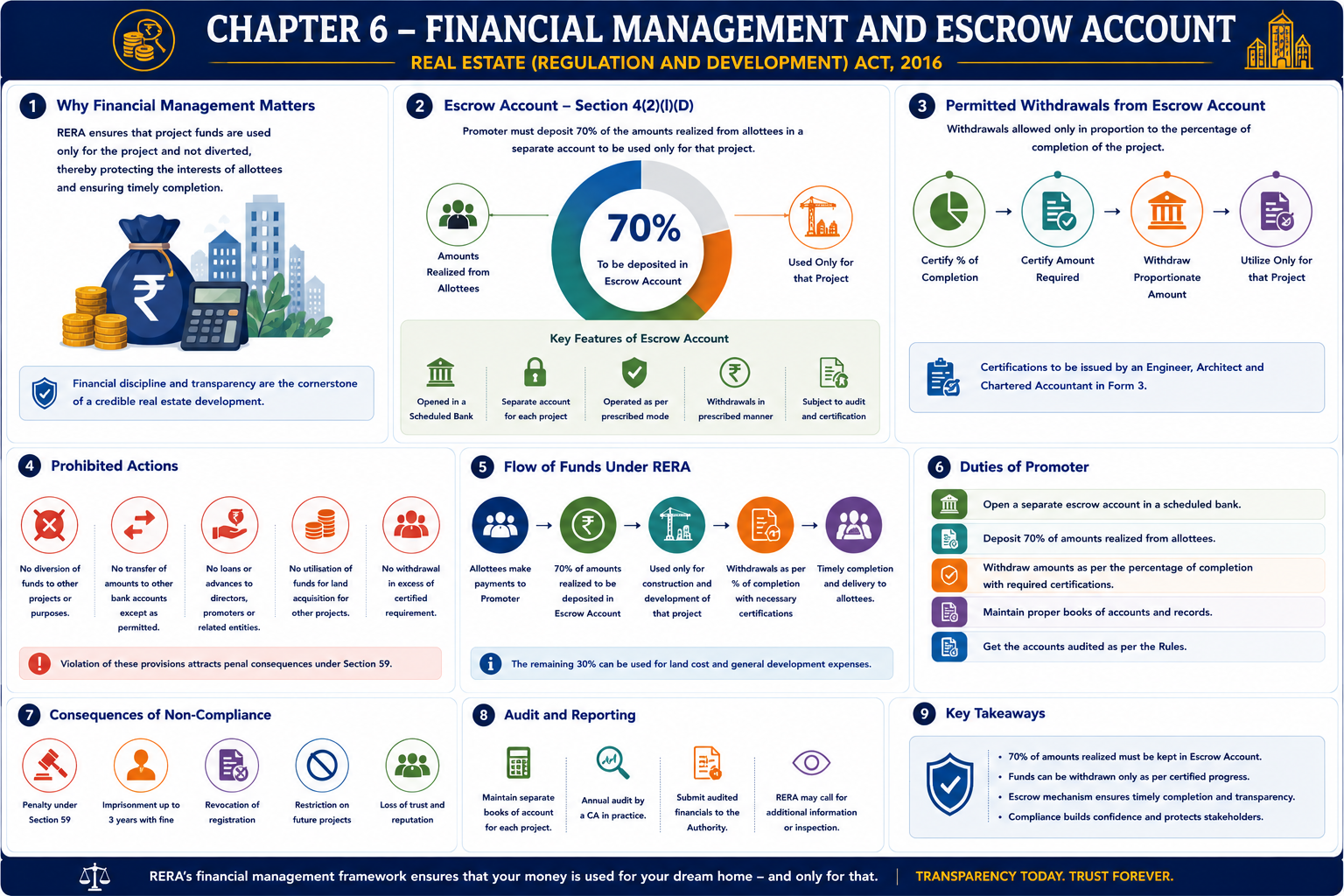
Objectives of Financial Discipline under RERA
The financial compliance provisions contained in the Act pursue multiple regulatory objectives. They seek to improve accountability, prevent diversion of project funds and create confidence among purchasers, lenders and investors. Transparent financial management also enables regulatory authorities to monitor project progress more effectively.
| Objective | Purpose |
|---|---|
| Prevent diversion of funds | Ensure that money collected from allottees is utilised only for the registered project. |
| Protect homebuyers | Reduce delays arising from financial mismanagement. |
| Improve transparency | Require periodic disclosures and financial reporting. |
| Enhance accountability | Subject withdrawals to professional certification and audit. |
| Promote timely completion | Link utilisation of funds with actual construction progress. |
The Separate Bank Account Requirement
Section 4(2)(l)(D) of RERA introduces one of the most important financial safeguards under the Act. Every promoter is required to deposit seventy per cent of the amounts realised from the allottees from time to time into a separate bank account maintained in a scheduled bank. The amount deposited in this account is intended to cover the cost of construction and the land cost relating to the registered project.
The statutory purpose of the separate account is to ensure that collections from one project are not diverted towards unrelated developments or business activities. Withdrawals from the account are strictly regulated and are linked to the percentage of completion of the project.
| Requirement | Statutory Position |
|---|---|
| Deposit Requirement | 70% of amounts realised from allottees must be deposited in a separate scheduled bank account. |
| Purpose | Meeting land cost and construction cost of the registered project. |
| Withdrawal | Permitted only in proportion to the percentage of completion. |
| Certification | Engineer, Architect and Chartered Accountant certification required before withdrawal. |
| Audit | Annual audit of project accounts is mandatory. |
Practice Note
The separate bank account is the cornerstone of RERA's financial discipline framework. Promoters should establish robust accounting systems from the commencement of the project to ensure that every withdrawal is properly supported by statutory certifications, accounting records and construction progress reports. Failure to maintain financial discipline frequently results in regulatory proceedings and substantial penalties.
The separate bank account is the cornerstone of RERA's financial discipline framework. Promoters should establish robust accounting systems from the commencement of the project to ensure that every withdrawal is properly supported by statutory certifications, accounting records and construction progress reports. Failure to maintain financial discipline frequently results in regulatory proceedings and substantial penalties.
Withdrawal of Funds from the Separate Account
Unlike ordinary commercial bank accounts, withdrawals from the designated RERA account cannot be made at the unrestricted discretion of the promoter. Every withdrawal must correspond with the percentage of completion of the project and must be supported by certificates issued by an Engineer, an Architect and a Chartered Accountant. This three-tier certification mechanism serves as an important safeguard against premature or excessive withdrawals.
| Professional | Role in Certification |
|---|---|
| Engineer | Certifies the stage of construction completed. |
| Architect | Certifies the extent of physical completion. |
| Chartered Accountant | Certifies the financial eligibility of the proposed withdrawal. |
Compliance Tip
Promoters should maintain project-wise accounting records, invoices, work completion reports and professional certificates in a systematic manner. Proper documentation not only facilitates statutory compliance but also assists during regulatory inspections, audits and dispute resolution proceedings.
Promoters should maintain project-wise accounting records, invoices, work completion reports and professional certificates in a systematic manner. Proper documentation not only facilitates statutory compliance but also assists during regulatory inspections, audits and dispute resolution proceedings.
Annual Audit of Project Accounts
Financial accountability under RERA extends beyond the maintenance of a separate bank account. Every promoter is required to have the accounts relating to each registered project audited within six months after the end of every financial year by a practising Chartered Accountant. The audit is intended to verify that the amounts collected for the project have been utilised for the purposes for which they were realised and that withdrawals from the separate bank account have been made in accordance with the percentage of completion of the project.
The audit requirement promotes financial transparency and enables the Regulatory Authority to verify compliance with the statutory safeguards introduced under the Act. It also provides confidence to allottees, lenders and investors regarding the financial health of the project.
| Audit Requirement | Purpose |
|---|---|
| Annual Project Audit | Verification of project accounts by a practising Chartered Accountant. |
| Certification of Utilisation | Confirm that project funds have been utilised only for the registered project. |
| Verification of Withdrawals | Ensure compliance with the percentage of completion requirement. |
| Submission to RERA | Facilitates regulatory oversight and financial transparency. |
Quarterly and Continuous Disclosures
Financial transparency under RERA is not confined to annual reporting. Promoters are required to make periodic disclosures on the State RERA portal relating to construction progress, approvals obtained, bookings, project status and other prescribed particulars. These disclosures enable allottees and prospective purchasers to monitor the progress of the project throughout its execution.
| Disclosure | Importance |
|---|---|
| Construction Progress | Tracks the stage-wise completion of the project. |
| Approvals Obtained | Confirms continuing statutory compliance. |
| Bookings | Promotes transparency in project sales. |
| Project Status | Keeps stakeholders informed regarding execution. |
| Financial Updates | Supports regulatory supervision and consumer confidence. |
Consequences of Financial Non-Compliance
Failure to maintain proper financial discipline may expose the promoter to regulatory action under RERA. Diversion of project funds, improper withdrawals from the separate account, inaccurate disclosures or failure to maintain prescribed records may result in penalties, regulatory directions and, in appropriate cases, prosecution under the Act.
| Default | Possible Consequence |
|---|---|
| Diversion of project funds | Regulatory proceedings, penalties and corrective directions. |
| Improper withdrawals | Violation of Section 4(2)(l)(D) requirements. |
| Failure to maintain accounts | Audit objections and regulatory action. |
| Non-submission of statutory disclosures | Penalties and compliance directions. |
| False financial information | Civil and statutory consequences under RERA. |
Practice Note
Promoters should view financial compliance as a continuous governance function rather than a year-end accounting exercise. Regular internal reviews, reconciliation of project accounts and timely statutory disclosures substantially reduce regulatory risk and facilitate smooth project execution.
Promoters should view financial compliance as a continuous governance function rather than a year-end accounting exercise. Regular internal reviews, reconciliation of project accounts and timely statutory disclosures substantially reduce regulatory risk and facilitate smooth project execution.
Financial Compliance Checklist
| ✓ | Open and maintain the designated project bank account. |
| ✓ | Deposit the prescribed percentage of allottee collections. |
| ✓ | Obtain Engineer, Architect and Chartered Accountant certifications before withdrawals. |
| ✓ | Maintain project-wise books of account. |
| ✓ | Upload quarterly disclosures on the RERA portal. |
| ✓ | Complete the annual statutory audit within the prescribed period. |
| ✓ | Preserve all supporting records and financial documents. |
Role of Professionals in Financial Compliance
The effectiveness of RERA's financial safeguards depends substantially upon the integrity and diligence of professionals associated with the project. Engineers, Architects, Chartered Accountants, Company Secretaries, Advocates and financial institutions each perform specialised functions that contribute to lawful project execution. Independent certification, accurate documentation and professional accountability collectively strengthen the regulatory framework established by the Act.
Professional Insight
An integrated compliance framework involving legal, financial and technical professionals not only satisfies statutory requirements but also enhances the credibility of the project before regulators, lenders and prospective purchasers.
An integrated compliance framework involving legal, financial and technical professionals not only satisfies statutory requirements but also enhances the credibility of the project before regulators, lenders and prospective purchasers.
Financial Governance under RERA
Financial governance under RERA extends beyond compliance with statutory accounting requirements. It represents a comprehensive framework of planning, transparency, accountability and professional oversight designed to ensure that every registered project is completed within the prescribed timelines while safeguarding the interests of allottees. Sound financial governance improves investor confidence, strengthens lender participation and significantly reduces regulatory intervention.
| Governance Principle | Practical Significance |
|---|---|
| Financial Transparency | Ensures complete disclosure of project finances and utilisation of funds. |
| Professional Certification | Independent verification before every withdrawal from the project account. |
| Continuous Monitoring | Periodic disclosures and regulatory supervision throughout the project lifecycle. |
| Independent Audit | Verification of compliance by a practising Chartered Accountant. |
| Accountability | Promotes responsible project management and consumer confidence. |
Lifecycle of Financial Compliance
Project Registration
        │
        ▼
Separate Bank Account
        │
        ▼
Collection of Funds
        │
        ▼
Professional Certification
        │
        ▼
Withdrawal Based on
Percentage of Completion
        │
        ▼
Quarterly Disclosures
        │
        ▼
Annual Audit
        │
        ▼
Project Completion
This flowchart may later be replaced with a professionally designed infographic for consistency with the remaining chapters.
Integrated Financial Compliance Checklist
| ✓ | Register the project before accepting bookings. |
| ✓ | Maintain the designated RERA bank account throughout the project. |
| ✓ | Deposit the prescribed percentage of collections without delay. |
| ✓ | Ensure withdrawals correspond with actual construction progress. |
| ✓ | Obtain Engineer, Architect and Chartered Accountant certifications. |
| ✓ | Maintain complete accounting records and supporting vouchers. |
| ✓ | Upload quarterly disclosures within the prescribed timelines. |
| ✓ | Complete annual audit and preserve audit reports. |
| ✓ | Retain all statutory records until completion of the project. |
Key Takeaways
- Financial discipline is one of the fundamental pillars of the Real Estate (Regulation and Development) Act, 2016.
- The separate bank account mechanism substantially reduces diversion of project funds.
- Professional certification before withdrawals promotes transparency and accountability.
- Quarterly disclosures and annual audits enable continuous regulatory supervision.
- Effective financial governance benefits promoters, lenders, homebuyers and regulators alike.
- Robust compliance systems significantly reduce litigation and regulatory exposure.
Further Reading
- Chapter 2 – Registration of Real Estate Projects & Real Estate Agents
- Chapter 3 – Rights and Duties of Promoters
- Chapter 5 – Agreement for Sale, Possession & Conveyance
- Chapter 8 – Offences, Penalties & Enforcement
- Relevant State RERA Rules relating to financial compliance and project accounts.
Concluding Note
Financial transparency is the foundation upon which the regulatory architecture of RERA rests. The statutory safeguards relating to project accounts, certification, disclosures and audit are intended not merely to regulate promoters but to build confidence among homebuyers, financial institutions and investors. Organisations that integrate legal, technical and financial compliance into their day-to-day project management are significantly better positioned to complete projects on time, minimise disputes and maintain long-term credibility in the real estate sector.
Financial transparency is the foundation upon which the regulatory architecture of RERA rests. The statutory safeguards relating to project accounts, certification, disclosures and audit are intended not merely to regulate promoters but to build confidence among homebuyers, financial institutions and investors. Organisations that integrate legal, technical and financial compliance into their day-to-day project management are significantly better positioned to complete projects on time, minimise disputes and maintain long-term credibility in the real estate sector.
Professional Disclaimer
This Guide has been prepared by AVP Legis Chambers for general educational and informational purposes only. While every effort has been made to ensure the accuracy of the information contained herein, the law relating to real estate regulation is continuously evolving through legislative amendments, State Rules, notifications, circulars and judicial pronouncements.
The contents of this Guide are intended to provide a practical overview of the Real Estate (Regulation and Development) Act, 2016 (RERA) and should not be construed as legal advice, legal opinion or a substitute for professional consultation. The applicability of RERA depends upon the facts of each case, the relevant State Rules and the latest judicial precedents.
Readers should obtain independent legal advice before making any investment decision, initiating or defending proceedings before a Real Estate Regulatory Authority, Adjudicating Officer, Real Estate Appellate Tribunal or any Court, or acting upon the information contained in this Guide.
References to statutory provisions, regulatory authorities, judicial decisions and procedural requirements are intended only for general guidance and may undergo modification with changes in law or interpretation by competent courts and authorities.
Neither AVP Legis Chambers nor the authors of this Guide accept any responsibility or liability for any loss, claim or consequence arising from reliance upon the information contained herein without obtaining appropriate professional advice.