x

INTEGRITY

│
Advocates
•
Solicitors
•
Mediators
•
Chartered Accountants
•
Insolvency Professionals
Advocates & Solicitors

Chapter 8 – Offences, Penalties & Enforcement
Introduction
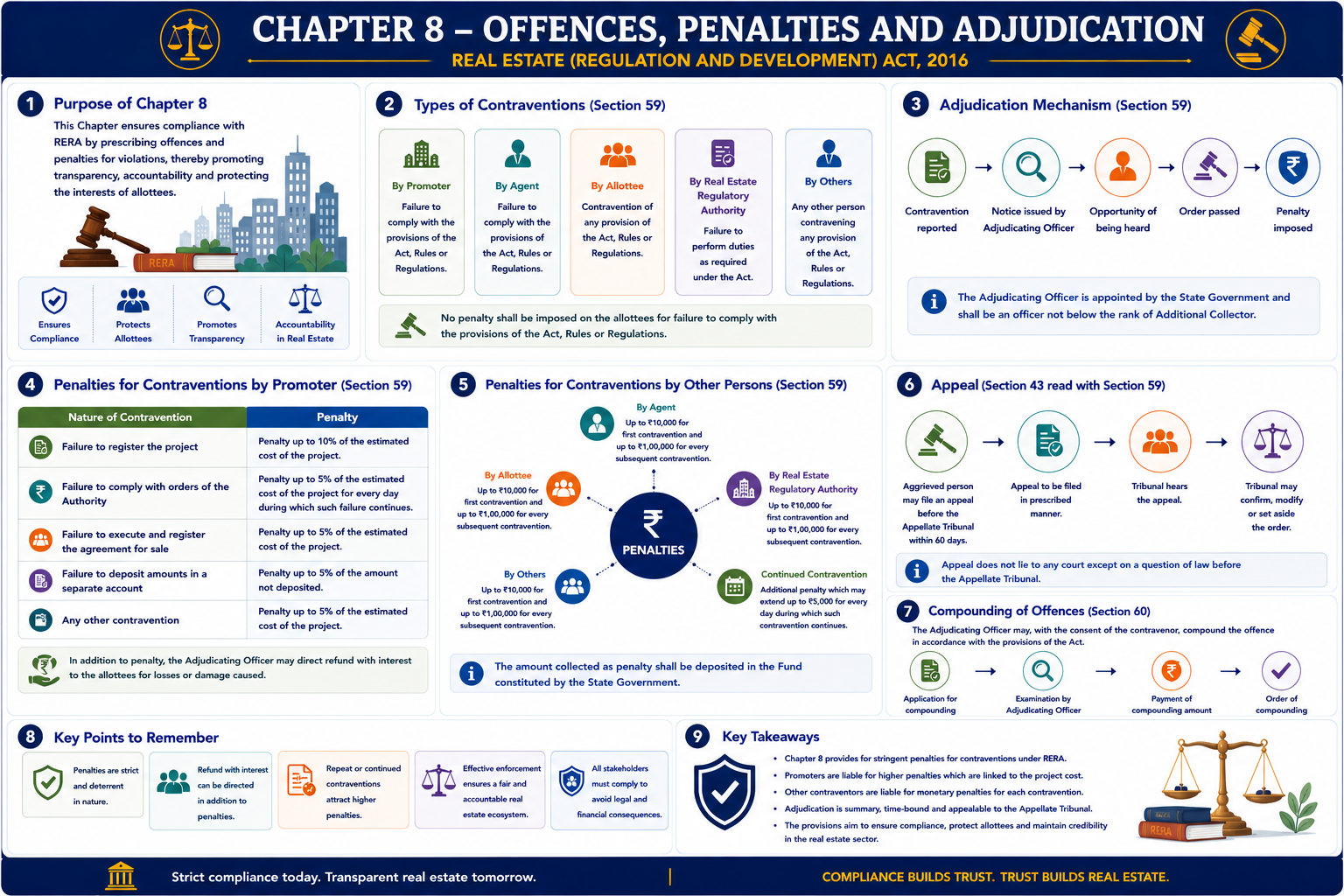
The Real Estate (Regulation and Development) Act, 2016 ("RERA") was enacted not merely to regulate the real estate sector but also to ensure effective enforcement of its provisions through a comprehensive system of civil consequences, monetary penalties and criminal sanctions. The success of any regulatory legislation depends upon its ability to secure compliance, and RERA therefore prescribes a graded framework of penalties applicable to promoters, real estate agents and allottees who violate their statutory obligations.
Prior to RERA, developers frequently delayed projects, diverted funds, launched projects without adequate approvals and failed to honour contractual commitments, while homebuyers had limited and time-consuming legal remedies. RERA fundamentally altered this landscape by empowering the Regulatory Authority to impose substantial penalties, issue binding directions, revoke project registrations and initiate prosecution in appropriate cases. The Act also recognises that compliance obligations extend beyond promoters and therefore prescribes penalties for registered real estate agents and allottees wherever statutory duties are breached.
The enforcement provisions contained in Chapters VIII and IX of the Act are intended to promote accountability rather than punishment alone. Monetary penalties are designed to secure compliance at the earliest stage, whereas imprisonment is generally reserved for persistent or wilful non-compliance with the orders of the Regulatory Authority or the Real Estate Appellate Tribunal. This balanced enforcement mechanism seeks to protect homebuyers without unnecessarily impeding genuine real estate development.
This chapter examines the various offences recognised under RERA, the penalties applicable to promoters, real estate agents and allottees, the circumstances in which imprisonment may be imposed, the concept of compounding of offences, and the practical implications of enforcement proceedings before the Regulatory Authority and the Appellate Tribunal.
Statutory Framework
The principal provisions governing offences, penalties and enforcement under the Real Estate (Regulation and Development) Act, 2016 are summarised below:
| Provision | Subject Matter |
|---|---|
| Sections 59–61 | Penalties for promoters, including failure to register projects and contravention of the provisions of the Act. |
| Section 62 | Penalty for contraventions committed by real estate agents. |
| Section 63 | Penalty for failure to comply with orders of the Regulatory Authority. |
| Section 64 | Consequences of failure to comply with orders of the Appellate Tribunal by promoters. |
| Section 65 | Penalty for failure to comply with orders of the Appellate Tribunal by real estate agents. |
| Section 66 | Penalty for failure to comply with orders of the Appellate Tribunal by allottees. |
| Section 67 | Compounding of offences. |
| Sections 68–72 | Recovery, adjudication and miscellaneous enforcement provisions. |
Practice Note
RERA follows the principle of graduated enforcement. Every statutory violation does not automatically result in imprisonment. In most cases, the Regulatory Authority initially exercises its regulatory powers through directions and monetary penalties. Criminal consequences generally arise only in cases of continued or deliberate non-compliance with statutory obligations or orders passed under the Act.
RERA follows the principle of graduated enforcement. Every statutory violation does not automatically result in imprisonment. In most cases, the Regulatory Authority initially exercises its regulatory powers through directions and monetary penalties. Criminal consequences generally arise only in cases of continued or deliberate non-compliance with statutory obligations or orders passed under the Act.
Objectives of the Penalty Framework
The enforcement mechanism under RERA serves multiple regulatory objectives. It is intended not merely to punish violations but to encourage voluntary compliance, protect consumer interests, maintain transparency in the real estate sector and strengthen confidence in housing transactions.
| Objective | Purpose |
|---|---|
| Consumer Protection | Safeguard the interests of homebuyers through effective enforcement. |
| Regulatory Compliance | Ensure adherence to registration requirements and statutory obligations. |
| Transparency | Discourage misleading advertisements, concealment of information and unfair trade practices. |
| Project Discipline | Promote timely completion of projects and responsible financial management. |
| Deterrence | Prevent repeated violations through proportionate monetary and criminal sanctions. |
Classification of Offences under RERA
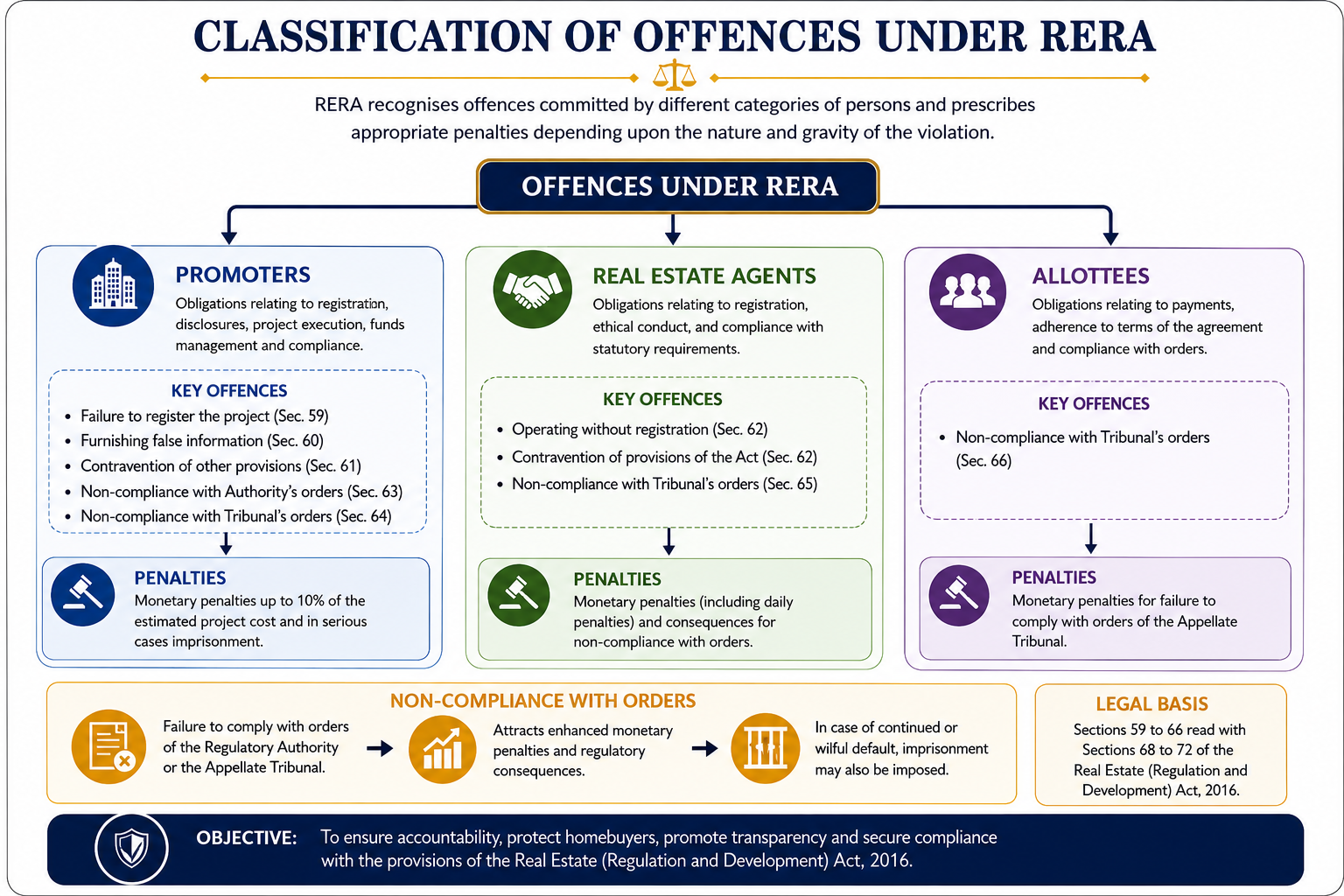
For practical purposes, offences under RERA may be grouped according to the category of person responsible for the default. This classification assists legal practitioners and stakeholders in identifying the applicable statutory provisions and the nature of potential consequences.
Key Principle
The severity of the consequences under RERA generally depends upon the nature of the statutory violation, the category of the person committing the default, and whether the violation involves mere regulatory non-compliance or deliberate disobedience of orders passed by the Regulatory Authority or the Appellate Tribunal.
The severity of the consequences under RERA generally depends upon the nature of the statutory violation, the category of the person committing the default, and whether the violation involves mere regulatory non-compliance or deliberate disobedience of orders passed by the Regulatory Authority or the Appellate Tribunal.
Penalties Applicable to Promoters
Promoters bear the highest degree of responsibility under the Real Estate (Regulation and Development) Act, 2016. Consequently, the Act prescribes the most stringent penalties for violations committed by promoters. These penalties are intended not merely to punish non-compliance but to ensure transparency, accountability and timely completion of registered projects.
The nature and quantum of penalty generally depend upon the gravity of the violation, whether the default is a first-time contravention or a continuing one, and whether the promoter has failed to comply with the orders of the Regulatory Authority or the Real Estate Appellate Tribunal.
| Statutory Provision | Nature of Contravention and Consequences |
|---|---|
| Section 59 | Failure to register a project before advertisement, marketing or sale. Monetary penalty which may extend up to ten per cent of the estimated cost of the real estate project. Continued default may also attract imprisonment. |
| Section 60 | Providing false information or documents while seeking project registration. Penalty extending up to five per cent of the estimated project cost. |
| Section 61 | Contravention of any other provision of the Act, Rules or Regulations where no specific penalty is prescribed. Penalty may extend up to five per cent of the estimated project cost. |
| Section 64 | Failure to comply with orders of the Appellate Tribunal. The Act provides for enhanced monetary penalties and, in appropriate cases, imprisonment. |
Practical Note
In practice, the most serious violations involve commencement of projects without registration, diversion of project funds, repeated delays in completion, suppression of material information and deliberate disregard of statutory directions issued by the Regulatory Authority.
In practice, the most serious violations involve commencement of projects without registration, diversion of project funds, repeated delays in completion, suppression of material information and deliberate disregard of statutory directions issued by the Regulatory Authority.
Penalties Applicable to Real Estate Agents
Real estate agents play a significant role in marketing and facilitating transactions relating to registered projects. RERA therefore requires agents dealing with projects covered by the Act to obtain registration and comply with prescribed statutory obligations.
| Provision | Nature of Default |
|---|---|
| Section 62 | Failure to comply with the provisions relating to registration or other obligations imposed under the Act. The Authority may impose a daily penalty, subject to the statutory maximum prescribed. |
| Section 65 | Failure to comply with orders passed by the Appellate Tribunal. Monetary penalties and other statutory consequences may follow. |
Penalties Applicable to Allottees
Although RERA is primarily intended to protect homebuyers, the Act also recognises that allottees must comply with their own contractual and statutory obligations. Persistent default in complying with lawful orders of the Appellate Tribunal may expose an allottee to monetary penalties under the Act.
| Provision | Nature of Default |
|---|---|
| Section 66 | Failure to comply with the orders of the Appellate Tribunal may result in monetary penalties in accordance with the provisions of the Act. |
Comparative Overview of Penalties
| Category | Principal Provisions | Nature of Consequences |
|---|---|---|
| Promoter | Sections 59–61 & 64 | Substantial monetary penalties, regulatory action and, in serious cases, imprisonment. |
| Real Estate Agent | Sections 62 & 65 | Registration-related penalties and consequences for non-compliance with Tribunal orders. |
| Allottee | Section 66 | Monetary penalties for failure to comply with Tribunal orders. |
Common Violations Encountered in Practice
| Common Violation | Likely Consequence under RERA |
|---|---|
| Launching a project without registration. | Proceedings under Section 59 together with regulatory directions. |
| False declarations during registration. | Penalty under Section 60. |
| Violation of statutory obligations under the Act. | Penalty under Section 61. |
| Failure to obey orders of the Regulatory Authority. | Proceedings under Section 63. |
| Failure to comply with Tribunal orders. | Enhanced penalties and other statutory consequences under Sections 64 to 66. |
Compliance Tip
Promoters should establish internal compliance systems to ensure timely project registration, accurate statutory disclosures, maintenance of project accounts, adherence to approved plans and prompt compliance with directions issued by the Regulatory Authority. Preventive compliance is significantly less costly than defending enforcement proceedings.
Promoters should establish internal compliance systems to ensure timely project registration, accurate statutory disclosures, maintenance of project accounts, adherence to approved plans and prompt compliance with directions issued by the Regulatory Authority. Preventive compliance is significantly less costly than defending enforcement proceedings.
Imprisonment and Criminal Consequences
Although the Real Estate (Regulation and Development) Act, 2016 is primarily a regulatory legislation, it also prescribes criminal consequences in cases of serious and persistent non-compliance. Imprisonment is generally not imposed for every statutory violation. Instead, the Act adopts a graduated enforcement approach whereby regulatory directions and monetary penalties constitute the primary means of securing compliance. Criminal sanctions are ordinarily attracted where promoters, real estate agents or allottees deliberately disregard the lawful orders of the Regulatory Authority or the Real Estate Appellate Tribunal.
The possibility of imprisonment reinforces the authority of the statutory forums and serves as a deterrent against wilful disobedience. Courts have consistently recognised that the effectiveness of regulatory legislation depends upon meaningful enforcement mechanisms capable of securing compliance with lawful orders.
Compounding of Offences – Section 67
Section 67 empowers the appropriate court to permit compounding of offences punishable with imprisonment under the Act, subject to payment of the prescribed sums and fulfilment of the conditions specified by the appropriate Government. Compounding avoids prolonged criminal proceedings while simultaneously ensuring compliance with statutory obligations and protecting the interests of affected stakeholders.
| Feature | Explanation |
|---|---|
| Nature of Relief | Settlement of the criminal prosecution in accordance with statutory provisions. |
| Applicable Authority | Competent Court exercising jurisdiction under the Act. |
| Conditions | Payment of prescribed amount and fulfilment of statutory requirements. |
| Objective | Encourage compliance while reducing avoidable criminal litigation. |
Recovery and Enforcement of Orders
Orders passed by the Regulatory Authority, the Adjudicating Officer and the Appellate Tribunal are enforceable in accordance with the provisions of the Act and the applicable State Rules. Failure to comply with such orders may result in additional penalties, prosecution or recovery proceedings. Effective enforcement is essential to preserve the credibility of the regulatory framework and to ensure that successful litigants receive meaningful relief.
Practical Compliance Checklist
| ✓ | Register every eligible project before advertisement or sale. |
| ✓ | Maintain complete and accurate statutory disclosures on the RERA portal. |
| ✓ | Ensure compliance with sanctioned plans and approved specifications. |
| ✓ | Maintain project accounts in accordance with statutory requirements. |
| ✓ | Promptly comply with every order passed by the Regulatory Authority or the Appellate Tribunal. |
| ✓ | Maintain proper records of approvals, correspondence, financial statements and project milestones. |
Enforcement Process under RERA
Statutory Violation
        │
        ▼
Inquiry by Regulatory Authority
        │
        ▼
Direction / Penalty
        │
        ▼
Failure to Comply
        │
        ▼
Appellate Tribunal
        │
        ▼
Enhanced Penalties /
Imprisonment (where applicable)
Key Takeaways
- RERA adopts a graded enforcement mechanism combining regulatory directions, monetary penalties and criminal sanctions.
- Promoters are subject to the most extensive compliance obligations and correspondingly stringent penalties.
- Real estate agents and allottees are also accountable for statutory defaults where specifically provided by the Act.
- Persistent non-compliance with orders of the Regulatory Authority or the Appellate Tribunal may attract severe legal consequences.
- Preventive compliance remains the most effective strategy for avoiding regulatory proceedings and financial exposure.
Further Reading
- Chapter 5 – Agreement for Sale, Possession & Conveyance
- Chapter 6 – Financial Discipline & Project Compliance
- Chapter 7 – Complaints, Adjudication & Appeals
- Relevant State RERA Rules relating to enforcement and adjudication.
Professional Note
Promoters, real estate agents and legal practitioners should view RERA's penalty provisions not merely as punitive measures but as part of a broader regulatory framework intended to ensure transparency, timely project completion and consumer confidence. Establishing robust internal compliance mechanisms is the most effective means of minimising regulatory exposure and avoiding enforcement proceedings.
Promoters, real estate agents and legal practitioners should view RERA's penalty provisions not merely as punitive measures but as part of a broader regulatory framework intended to ensure transparency, timely project completion and consumer confidence. Establishing robust internal compliance mechanisms is the most effective means of minimising regulatory exposure and avoiding enforcement proceedings.
Professional Disclaimer
This Guide has been prepared by AVP Legis Chambers for general educational and informational purposes only. While every effort has been made to ensure the accuracy of the information contained herein, the law relating to real estate regulation is continuously evolving through legislative amendments, State Rules, notifications, circulars and judicial pronouncements.
The contents of this Guide are intended to provide a practical overview of the Real Estate (Regulation and Development) Act, 2016 (RERA) and should not be construed as legal advice, legal opinion or a substitute for professional consultation. The applicability of RERA depends upon the facts of each case, the relevant State Rules and the latest judicial precedents.
Readers should obtain independent legal advice before making any investment decision, initiating or defending proceedings before a Real Estate Regulatory Authority, Adjudicating Officer, Real Estate Appellate Tribunal or any Court, or acting upon the information contained in this Guide.
References to statutory provisions, regulatory authorities, judicial decisions and procedural requirements are intended only for general guidance and may undergo modification with changes in law or interpretation by competent courts and authorities.
Neither AVP Legis Chambers nor the authors of this Guide accept any responsibility or liability for any loss, claim or consequence arising from reliance upon the information contained herein without obtaining appropriate professional advice.