x
INTEGRITY
│
Advocates
•
Solicitors
•
Mediators
•
Chartered Accountants
•
Insolvency Professionals
Advocates & Solicitors
Chapter 5 – Agreement for Sale, Possession & Conveyance under RERA
Introduction
The Agreement for Sale is the most significant contractual document executed between a promoter and an allottee under the Real Estate (Regulation and Development) Act, 2016 ("RERA"). It defines the legal relationship between the parties, records their respective rights and obligations, specifies the financial terms of the transaction, and establishes the timeline for completion and delivery of possession. Recognising the imbalance that historically existed between developers and homebuyers, RERA introduced mandatory safeguards governing the execution and contents of the Agreement for Sale, thereby ensuring greater transparency, fairness and accountability in real estate transactions.
Prior to the enactment of RERA, many developers accepted substantial advances from purchasers without executing formal agreements, incorporated one-sided contractual clauses, altered project specifications after booking, or delayed possession without meaningful consequences. The absence of uniform statutory standards frequently resulted in prolonged litigation and uncertainty regarding the rights of homebuyers. Sections 13 and 17 of RERA, read with the applicable State Rules, were enacted to address these concerns by prescribing when an Agreement for Sale must be executed, restricting the amount that may be collected before its execution, and regulating the transfer of title through a registered conveyance deed.
Equally important are the concepts of possession and conveyance. Delivery of possession is not merely the physical handing over of the apartment, plot or building; it is preceded by statutory compliances such as obtaining the Completion Certificate or Occupancy Certificate, wherever applicable. Conveyance, on the other hand, legally transfers ownership in favour of the allottee or the Association of Allottees and marks the culmination of the promoter's principal obligations under the Act.
This chapter examines the statutory framework governing the Agreement for Sale, restrictions on advance payments, mandatory contractual disclosures, possession, occupancy and completion certificates, execution of conveyance deeds, and the practical precautions that purchasers, promoters and legal practitioners should adopt while drafting, reviewing or enforcing such agreements.
Statutory Framework
The provisions relating to the Agreement for Sale, possession and conveyance are primarily contained in the following sections of the Real Estate (Regulation and Development) Act, 2016:
| Provision | Subject Matter |
|---|---|
| Section 13 | Restrictions on acceptance of advance payment and execution of the Agreement for Sale. |
| Section 17 | Transfer of title and execution of the registered conveyance deed. |
| Section 18 | Compensation, refund and interest in case of delay or failure to hand over possession. |
| Section 19 | Rights of the allottee relating to possession and documentation. |
| Relevant State RERA Rules | Model Agreement for Sale, timelines, forms and procedural requirements. |
Practice Note
The Agreement for Sale should never be treated as a routine formality. It is the principal document that governs the legal relationship between the promoter and the allottee. Before signing, every purchaser should verify that the agreement accurately reflects the sanctioned plans, carpet area, payment schedule, completion timeline, amenities, and the promoter's statutory obligations under RERA.
The Agreement for Sale should never be treated as a routine formality. It is the principal document that governs the legal relationship between the promoter and the allottee. Before signing, every purchaser should verify that the agreement accurately reflects the sanctioned plans, carpet area, payment schedule, completion timeline, amenities, and the promoter's statutory obligations under RERA.
Introduction
The Real Estate (Regulation and Development) Act, 2016 ("RERA") was enacted to restore confidence in the real estate sector by balancing the rights and obligations of all stakeholders. While the Act places significant responsibilities upon promoters and real estate agents, it equally recognises that allottees are central participants in every real estate project and therefore deserve statutory protection against unfair practices, delays, and misinformation.
Prior to RERA, homebuyers often faced prolonged delays in possession, arbitrary alterations in project plans, misleading advertisements, diversion of project funds, and the absence of an effective grievance redressal mechanism. RERA addresses these concerns by granting allottees enforceable legal rights, including the right to receive complete project information, timely possession, refunds, interest for delay, compensation, execution of conveyance deeds, and protection against structural defects.
The Act also casts corresponding duties upon allottees. Timely payment of instalments, compliance with the Agreement for Sale, participation in the formation of the association of allottees, and cooperation in project completion are essential for ensuring the successful execution and long-term management of a real estate project.
This chapter examines the statutory Agreement for Sale, Possession & Conveyance under RERA, the remedies available in case of promoter defaults, and the responsibilities that purchasers must discharge to ensure compliance with the Act. The discussion is intended to provide practical guidance to homebuyers, legal practitioners, developers, financial institutions, and all stakeholders involved in the real estate sector.
Who is an Allottee?
The term "allottee" has been defined under Section 2(d) of the Real Estate (Regulation and Development) Act, 2016. The definition is intentionally broad so as to cover every person who acquires an interest in a real estate project from the promoter, irrespective of whether the acquisition is by way of sale, allotment, transfer or any other recognised mode.
An allottee is the principal beneficiary of the protections created under RERA. The Act recognises that persons investing in residential or commercial real estate often commit substantial financial resources long before completion of construction. Consequently, they are entitled to statutory safeguards against delays, misrepresentations, arbitrary alterations, diversion of project funds and other unfair practices.
However, the expression does not include a person to whom a property is transferred merely by way of resale after completion of the project unless the rights under the original allotment are validly assigned. Likewise, tenants, licensees or occupants who have not acquired ownership rights from the promoter are generally outside the scope of the statutory definition.
| Included within the Definition of Allottee | Examples |
|---|---|
| Individual purchaser | A person purchasing an apartment for self-use or investment. |
| Joint purchasers | Husband and wife or family members purchasing jointly. |
| Companies and LLPs | Corporate entities purchasing commercial or residential units. |
| Partnership Firms and Trusts | Entities acquiring property through authorised representatives. |
| Assignees | Persons lawfully obtaining rights from an original allottee. |
Objectives Behind Protecting Allottees
RERA seeks to establish a fair and transparent relationship between promoters and purchasers. Instead of treating buyers merely as consumers under contractual arrangements, the Act recognises them as statutory stakeholders entitled to enforceable rights throughout the lifecycle of a real estate project.
The legislative scheme seeks to ensure transparency, accountability, financial discipline and timely completion of projects while simultaneously providing effective remedies where promoters fail to fulfil their statutory obligations.
| Objective | Purpose |
|---|---|
| Transparency | Enable purchasers to make informed investment decisions. |
| Accountability | Hold promoters responsible for statutory and contractual obligations. |
| Consumer Protection | Safeguard purchasers against unfair trade practices and delays. |
| Timely Completion | Reduce stalled and indefinitely delayed real estate projects. |
| Efficient Dispute Resolution | Provide specialised adjudicatory forums under RERA. |
Statutory Rights of Allottees under RERA
The rights of allottees are principally contained in Section 19 of the Real Estate (Regulation and Development) Act, 2016, though several other provisions of the Act supplement these rights. Together, they establish a comprehensive legal framework ensuring transparency, accountability and timely delivery of real estate projects. These rights are statutory in nature and cannot ordinarily be diluted by contractual clauses inconsistent with the provisions of RERA.
An allottee is entitled not only to receive possession of the apartment, plot or building within the agreed timeline but also to remain informed about every material aspect of the project. Where the promoter defaults in performing statutory or contractual obligations, RERA provides remedies in the form of refund, interest, compensation and adjudicatory proceedings before the Real Estate Regulatory Authority or the Adjudicating Officer.
| Sl. | Right | Relevant Provision | Nature of Protection |
|---|---|---|---|
| 1 | Right to obtain complete project information | Section 19(1) | Access to sanctioned plans, layout plans, specifications and project details. |
| 2 | Right to know the stage-wise schedule of completion | Section 19(1) | Continuous transparency regarding construction progress. |
| 3 | Right to claim possession | Section 19(10) | Delivery of possession in accordance with the Agreement for Sale. |
| 4 | Right to refund | Sections 18 & 19 | Refund with interest where the promoter defaults. |
| 5 | Right to interest for delay | Section 18 | Compensation for delayed possession without cancelling the allotment. |
| 6 | Right to compensation | Sections 12, 14 & 18 | Compensation for false representations, defective title and statutory breaches. |
| 7 | Right to participate in the Association of Allottees | Sections 11 & 19 | Participation in management and maintenance of the project. |
| 8 | Right to execution of conveyance deed | Section 17 | Transfer of legal title after completion of the project. |
| 9 | Right against structural defects | Section 14(3) | Rectification of structural defects during the statutory defect liability period. |
Flow of Rights Available to an Allottee
Booking of Unit
        │
        ▼
Execution of Agreement for Sale
        │
        ▼
Construction & Periodic Disclosures
        │
        ▼
Inspection of Project Progress
        │
        ▼
Completion / Occupancy Certificate
        │
        ▼
Offer of Possession
        │
        ▼
Conveyance Deed
        │
        ▼
Formation of Association & Project Management
Why Section 19 is Significant
Section 19 transforms the position of a homebuyer from that of a passive purchaser to a statutory stakeholder in the project. The promoter is no longer free to rely solely upon contractual clauses; compliance with the mandatory provisions of RERA is enforceable before the Regulatory Authority, the Adjudicating Officer and the Appellate Tribunal.
Section 19 transforms the position of a homebuyer from that of a passive purchaser to a statutory stakeholder in the project. The promoter is no longer free to rely solely upon contractual clauses; compliance with the mandatory provisions of RERA is enforceable before the Regulatory Authority, the Adjudicating Officer and the Appellate Tribunal.
1. Right to Obtain Complete Project Information
Section 19(1) of RERA grants every allottee the right to obtain complete and accurate information relating to the real estate project. Transparency is one of the foundational principles of the Act, requiring promoters to disclose all material particulars before accepting bookings and throughout the execution of the project.
An allottee is entitled to inspect and obtain copies of sanctioned plans, layout plans, specifications, approvals from competent authorities, project registration details, construction schedules and quarterly progress reports uploaded on the State RERA portal. This continuous disclosure mechanism enables purchasers to make informed decisions and monitor the progress of construction.
| Information Available | Purpose |
|---|---|
| Approved Layout & Building Plans | Verify that construction conforms to sanctioned approvals. |
| Project Registration Details | Confirm validity of registration and project particulars. |
| Quarterly Progress Reports | Monitor construction and financial progress. |
| Approvals & Licences | Ensure statutory compliance by the promoter. |
| Litigation Disclosures | Assess legal risks affecting the project. |
2. Right to Know the Stage-wise Schedule of Completion
The promoter is under a continuing obligation to disclose the expected schedule of completion and the stage-wise progress of construction. Timely disclosure enables allottees to plan financing, possession and occupation while also reducing uncertainty regarding project completion.
If there is any material deviation from the declared schedule, the promoter must update the disclosures in accordance with the requirements of RERA and the applicable State Rules.
Practical Tip
Compare the construction status reflected on the RERA portal with the actual physical progress at the site. Any substantial discrepancy should immediately be brought to the notice of the promoter and, if necessary, the Regulatory Authority.
Compare the construction status reflected on the RERA portal with the actual physical progress at the site. Any substantial discrepancy should immediately be brought to the notice of the promoter and, if necessary, the Regulatory Authority.
3. Right to Timely Possession
The right to receive possession within the agreed timeline is one of the most valuable statutory protections available to an allottee. The Agreement for Sale specifies the expected date of completion and possession. Failure to honour this commitment without lawful justification exposes the promoter to liability under the Act.
Before possession is handed over, the promoter must obtain the Completion Certificate or Occupancy Certificate, wherever applicable, and complete all statutory formalities. Possession offered without the necessary approvals may expose the allottee to future legal and municipal complications.
Booking
   │
Agreement for Sale
   │
Construction
   │
Completion / Occupancy Certificate
   │
Notice of Possession
   │
Physical Possession
4. Right to Refund
One of the most significant remedies available to an allottee under RERA is the right to seek refund of the amount paid where the promoter fails to fulfil his statutory or contractual obligations. If the promoter is unable to complete the project or hand over possession in accordance with the terms of the Agreement for Sale, the allottee may choose to withdraw from the project and claim refund together with interest prescribed under the applicable Rules.
The remedy of refund is intended to restore the allottee to the financial position that existed prior to the investment. Depending upon the circumstances, compensation may also be awarded where the allottee has suffered additional loss due to the promoter's default.
| Situation | Relief Available |
|---|---|
| Delay in handing over possession | Refund with interest or continue with interest for delay. |
| Project abandoned | Refund of the entire amount paid together with applicable interest. |
| Registration revoked | Appropriate statutory relief including refund where warranted. |
| Promoter unable to complete the project | Refund and compensation, depending upon the facts. |
5. Right to Interest for Delay
An allottee is not required to withdraw from the project merely because possession has been delayed. Where the allottee elects to continue with the project, the promoter remains liable to pay interest for the period of delay until actual possession is delivered. This statutory mechanism compensates purchasers for the financial burden arising from delayed completion while preserving their right to receive the property.
The applicable rate of interest is prescribed under the Rules framed under RERA and is generally linked to a recognised benchmark lending rate. The entitlement to interest operates independently of the promoter's contractual stipulations where such stipulations are inconsistent with the Act.
Important Principle
The choice between seeking refund and continuing with the project ordinarily rests with the allottee. RERA seeks to protect the purchaser rather than compel cancellation of the allotment.
The choice between seeking refund and continuing with the project ordinarily rests with the allottee. RERA seeks to protect the purchaser rather than compel cancellation of the allotment.
6. Right to Compensation
Apart from refund and statutory interest, an allottee may claim compensation where loss has been caused by false advertisements, misleading statements, defective title, structural defects, breach of statutory obligations or other violations committed by the promoter. Compensation is intended to reimburse actual loss suffered and may be awarded by the Adjudicating Officer in appropriate cases.
While every delay may not automatically result in compensation, deliberate misrepresentation, concealment of material facts or failure to comply with statutory obligations may expose the promoter to substantial financial liability under the Act.
| Ground for Compensation | Illustrative Example |
|---|---|
| False Advertisement | Promised amenities not provided. |
| Incorrect Information | Misrepresentation regarding approvals or carpet area. |
| Defective Title | Promoter lacks marketable title to the land. |
| Structural Defects | Major defects appearing within the statutory liability period. |
| Other Statutory Breaches | Violation of mandatory provisions of RERA causing loss to allottees. |
7. Right to Approved Plans and Specifications
Every allottee is entitled to receive the apartment, plot or building substantially in accordance with the sanctioned plans, specifications and amenities represented by the promoter. Material alterations or additions cannot ordinarily be made without complying with the requirements prescribed under RERA and the Agreement for Sale.
This protection prevents arbitrary modifications that may adversely affect the value, utility or enjoyment of the property purchased by the allottee.
| Nature of Change | General Position under RERA |
|---|---|
| Minor architectural adjustments | Permissible where authorised by law and agreement. |
| Major structural alteration | Requires compliance with statutory provisions and, where applicable, consent of allottees. |
| Reduction in promised amenities | May constitute a breach giving rise to statutory remedies. |
| Change in sanctioned layout | Subject to the restrictions imposed by RERA. |
Practice Note
Before taking possession, every allottee should compare the completed unit with the sanctioned plans, specifications and amenities promised in the Agreement for Sale. Any deviation should be immediately recorded in writing and communicated to the promoter.
Before taking possession, every allottee should compare the completed unit with the sanctioned plans, specifications and amenities promised in the Agreement for Sale. Any deviation should be immediately recorded in writing and communicated to the promoter.
8. Right to Formation of Association of Allottees
RERA recognises that the long-term management of a real estate project should ultimately vest with the purchasers themselves. Accordingly, the promoter is required to facilitate the formation of an Association, Society, Cooperative Society or Federation of Allottees, as may be applicable under the laws of the State.
The Association represents the collective interests of the allottees and plays a vital role in the maintenance, administration and management of the project after completion. It also serves as the principal body for protecting the rights of purchasers in relation to common areas and common facilities.
| Function of the Association | Purpose |
|---|---|
| Maintenance of Common Areas | Ensure proper upkeep of shared facilities. |
| Collection of Maintenance Charges | Meet recurring operational expenses. |
| Representation of Allottees | Collectively protect the interests of purchasers. |
| Management of Common Assets | Administer common property after conveyance. |
9. Right to Execution of Conveyance Deed
After obtaining the Completion Certificate or Occupancy Certificate, as applicable, the promoter is required to execute a registered conveyance deed in favour of the allottee or the Association of Allottees within the period prescribed under the Act and the applicable State Rules.
Execution of the conveyance deed transfers legal ownership and enables the Association to administer the common areas and common facilities in accordance with law.
10. Right Against Structural Defects
Section 14(3) of RERA provides one of the most important consumer protections under the Act. If any structural defect or defect in workmanship, quality or provision of services is noticed within five years from the date of handing over possession, the promoter must rectify the defect without further charge within the prescribed period.
If the promoter fails to rectify the defect within the statutory period, the allottee becomes entitled to claim appropriate compensation in accordance with the provisions of the Act.
Remember
The statutory defect liability period under RERA is available only for defects reported within the period prescribed by law. Purchasers should therefore inspect the property thoroughly and report all defects promptly in writing.
The statutory defect liability period under RERA is available only for defects reported within the period prescribed by law. Purchasers should therefore inspect the property thoroughly and report all defects promptly in writing.
Duties of Allottees
While RERA provides extensive statutory protections to allottees, it also imposes corresponding responsibilities. A successful real estate project depends upon cooperation between promoters and purchasers. Failure on the part of an allottee to comply with contractual and statutory obligations may itself result in legal consequences.
| Duty | Description |
|---|---|
| Timely Payment | Pay instalments, taxes and other charges in accordance with the Agreement for Sale. |
| Execution of Documents | Execute the conveyance deed and other documents whenever required. |
| Take Possession | Accept possession after lawful offer by the promoter. |
| Participate in the Association | Join and cooperate with the Association of Allottees. |
| Observe Project Rules | Comply with lawful rules relating to maintenance and common facilities. |
Practical Checklist for Allottees
Before Booking
- ✔ Verify RERA Registration.
- ✔ Examine approved plans and specifications.
- ✔ Verify title and statutory approvals.
- ✔ Carefully read the Agreement for Sale.
- ✔ Preserve every advertisement and brochure.
Before Taking Possession
- ✔ Inspect the apartment thoroughly.
- ✔ Verify the Completion/Occupancy Certificate.
- ✔ Test essential services and utilities.
- ✔ Record defects in writing.
- ✔ Obtain copies of all relevant documents.
Common Mistakes by Allottees
- Booking projects without verifying RERA registration.
- Ignoring the sanctioned plans and approvals.
- Depending solely upon promotional material.
- Failing to preserve payment receipts and correspondence.
- Accepting possession without inspection.
- Delaying complaints despite noticing defects.
- Not participating in the Association of Allottees.
Practice Notes for Stakeholders
For Homebuyers
Conduct proper due diligence before booking, preserve documentary evidence throughout the transaction, and immediately report any deviation from sanctioned plans or promised specifications.
Conduct proper due diligence before booking, preserve documentary evidence throughout the transaction, and immediately report any deviation from sanctioned plans or promised specifications.
1. Agreement for Sale – Section 13
Section 13 of RERA prohibits a promoter from accepting more than ten per cent of the cost of the apartment, plot or building as an advance payment or application fee without first entering into a written Agreement for Sale and registering the same, wherever registration is required by law. This provision was introduced to eliminate the widespread practice of collecting substantial amounts from purchasers without creating a legally enforceable contractual relationship.
The Agreement for Sale serves as the principal document governing the rights and obligations of both parties. It records the commercial terms of the transaction, identifies the property agreed to be transferred, prescribes the payment schedule, specifies the date of possession and incorporates the statutory safeguards mandated by RERA and the applicable State Rules.
Statutory Restriction
A promoter cannot accept more than 10% of the agreed sale consideration as advance payment or application money without first executing the Agreement for Sale.
A promoter cannot accept more than 10% of the agreed sale consideration as advance payment or application money without first executing the Agreement for Sale.
Why Section 13 Was Introduced
Prior to RERA, many purchasers paid substantial booking amounts merely on the basis of brochures, application forms or allotment letters. Formal agreements were often executed months later after significant sums had already been collected. This unequal bargaining position enabled promoters to introduce unilateral contractual clauses or alter project specifications after accepting payments.
Section 13 addresses these concerns by ensuring that both parties enter into a legally binding agreement at an early stage of the transaction, thereby promoting certainty, transparency and accountability.
| Before RERA | Position under RERA |
|---|---|
| Large advances collected without formal agreement. | Advance beyond 10% prohibited without Agreement for Sale. |
| One-sided contractual terms. | Agreement governed by statutory requirements. |
| Frequent disputes regarding possession dates. | Possession timeline incorporated in the Agreement. |
| Limited disclosure obligations. | Mandatory disclosures under RERA. |
Essential Contents of the Agreement for Sale
Although the precise format may vary according to the applicable State Rules, every Agreement for Sale should clearly identify the parties, accurately describe the property, specify the financial terms and incorporate all mandatory statutory disclosures required under RERA.
| Essential Clause | Purpose |
|---|---|
| Description of the Property | Identifies the apartment, plot or building together with the carpet area. |
| Sale Consideration | Specifies the total price and applicable taxes. |
| Payment Schedule | Records milestone-based payments and due dates. |
| Date of Possession | Defines the agreed timeline for handing over possession. |
| Specifications & Amenities | Records the quality, facilities and common amenities promised. |
| Default Clauses | Provides consequences of breach by either party. |
| Interest & Compensation | Incorporates statutory remedies available under RERA. |
| Force Majeure | Specifies circumstances beyond the promoter's control. |
| Dispute Resolution | Records statutory remedies available under RERA. |
Typical Lifecycle of an Agreement for Sale
Booking of Unit
        │
Application & Initial Deposit
        │
Agreement for Sale
        │
Registration of Agreement
        │
Construction
        │
Milestone Payments
        │
Completion / Occupancy Certificate
        │
Offer of Possession
        │
Conveyance Deed
Key Principle
The Agreement for Sale is not merely a commercial contract. It is a statutory document whose terms must conform to the mandatory provisions of RERA. Any clause that seeks to defeat or substantially dilute the rights conferred upon an allottee under the Act may be open to challenge before the appropriate authority.
The Agreement for Sale is not merely a commercial contract. It is a statutory document whose terms must conform to the mandatory provisions of RERA. Any clause that seeks to defeat or substantially dilute the rights conferred upon an allottee under the Act may be open to challenge before the appropriate authority.
For Promoters
Maintain complete transparency in disclosures, adhere to possession timelines and promptly address legitimate grievances raised by allottees.
Maintain complete transparency in disclosures, adhere to possession timelines and promptly address legitimate grievances raised by allottees.
For Legal Practitioners
Examine the Agreement for Sale together with statutory disclosures on the State RERA portal before advising clients. The appropriate remedy may differ depending upon whether the client seeks possession, refund, interest or compensation.
Examine the Agreement for Sale together with statutory disclosures on the State RERA portal before advising clients. The appropriate remedy may differ depending upon whether the client seeks possession, refund, interest or compensation.
Key Takeaways
- RERA recognises the allottee as a statutory stakeholder entitled to extensive legal protection.
- Transparency, timely possession and accountability are the guiding principles of the Act.
- The principal remedies include possession, refund, interest, compensation and rectification of structural defects.
- Every allottee should verify the project on the State RERA portal before investing.
- Maintaining proper documentation substantially strengthens an allottee's legal remedies in the event of a dispute.
- The rights of allottees are balanced by duties such as timely payment, cooperation with the promoter and participation in the Association of Allottees.
4. Right to Refund
Where the promoter fails to complete or is unable to hand over possession in accordance with the Agreement for Sale, the allottee may withdraw from the project and claim refund of the entire amount paid together with interest prescribed under the applicable Rules.
Refund may also become available where the project is abandoned, registration is revoked, construction becomes impossible or the promoter otherwise commits a substantial breach of statutory obligations.
| Situation | Remedy Available |
|---|---|
| Unreasonable delay in possession | Refund with statutory interest. |
| Project abandoned | Refund. |
| Project registration revoked | Refund or other statutory relief. |
| Promoter unable to complete project | Refund and compensation, where applicable. |
5. Right to Interest for Delay
Instead of withdrawing from the project, an allottee may elect to continue with the allotment and claim interest for every period of delay until possession is actually delivered. This enables purchasers to retain the booked property while receiving monetary compensation for the delay.
The applicable rate of interest is prescribed under the relevant Rules framed under RERA and generally remains linked to a benchmark lending rate notified from time to time.
6. Right to Compensation
Apart from refund and statutory interest, an allottee may claim compensation where loss has been suffered due to false advertisements, misleading representations, defective title, structural defects or any other contravention of the provisions of the Act.
Claims for compensation are ordinarily adjudicated by the Adjudicating Officer appointed under RERA after considering the evidence produced by the parties.
Key Principle
RERA remedies are intended not merely to punish defaulting promoters but to restore the financial and legal position of allottees affected by statutory or contractual violations.
RERA remedies are intended not merely to punish defaulting promoters but to restore the financial and legal position of allottees affected by statutory or contractual violations.
Key Takeaways
- Promoters are subject to extensive statutory obligations under Sections 11–18 of RERA.
- Transparency and timely completion form the foundation of promoter compliance.
- False advertisements and misleading representations may result in compensation and regulatory action.
- Transfer of projects requires statutory approvals and protection of allottees' interests.
- Proper documentation is essential for both compliance and dispute resolution.
Statutory Duties under RERA
Sections 11 to 18 of the Real Estate (Regulation and Development) Act, 2016 prescribe the principal obligations of promoters. These provisions ensure transparency, timely completion of projects and protection of the interests of allottees.
| Provision | Subject |
|---|---|
| Section 11 | Functions and duties of promoters. |
| Section 12 | Liability for false or misleading advertisement. |
| Section 13 | Execution of Agreement for Sale. |
| Section 14 | Adherence to sanctioned plans and project specifications. |
| Section 15 | Transfer of promoter's rights and liabilities. |
| Section 16 | Insurance of the project. |
| Section 17 | Transfer of title and handing over of documents. |
| Section 18 | Refund, interest and compensation. |
Transfer of Project
A promoter cannot transfer or assign the majority rights and liabilities in a registered real estate project to another person without obtaining the prior written consent of at least two-thirds of the allottees (excluding the promoter's own units) and the prior approval of the Real Estate Regulatory Authority.
Liability for False Advertisement
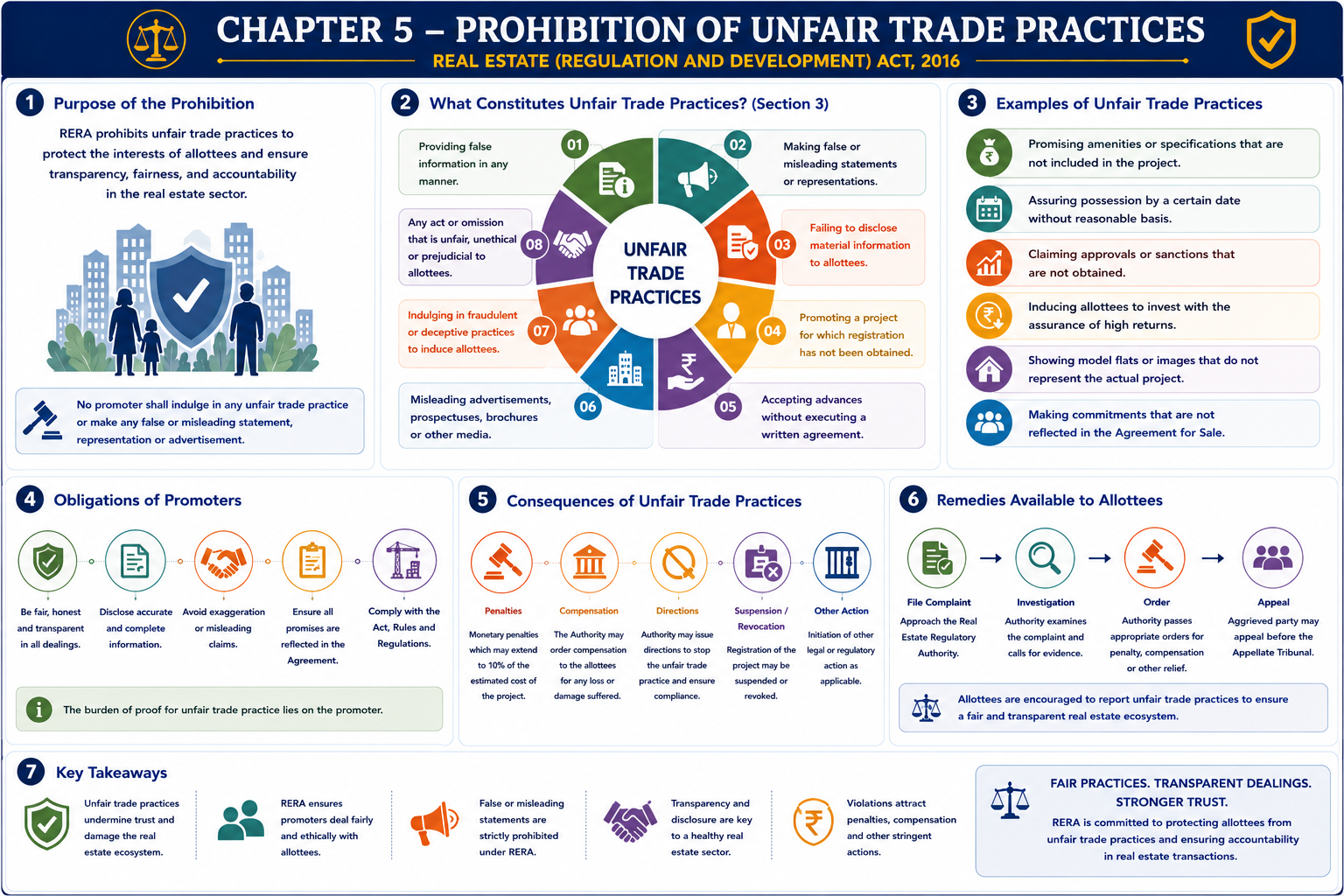
Where any person makes an investment based on a false or misleading advertisement or prospectus issued by the promoter and suffers loss, such person is entitled to claim compensation under Section 12 of the Act.
Practice Note
Advertisements, brochures, websites, social media promotions and email communications often become crucial documentary evidence in proceedings before the Regulatory Authority. Promoters should ensure that every representation accurately reflects the sanctioned plans and statutory approvals.
Consequences of Non-Compliance
| Default | Likely Consequence |
|---|---|
| Delay in possession | Refund, interest or compensation as provided under Section 18. |
| False advertisement | Compensation to affected allottees. |
| Violation of sanctioned plans | Directions, penalties and other regulatory action. |
| Breach of statutory obligations | Proceedings before the Regulatory Authority and Appellate Tribunal. |
State Practice Note
Although RERA is a Central legislation, every State has framed its own Rules and administrative procedures. Advocates should always verify the applicable State Rules, notifications and the latest directions issued by the concerned State Real Estate Regulatory Authority before advising clients.
Practical Checklist for Advocates
Verify
Registration details, sanctioned plans and title documents.
Examine
Agreement for Sale and statutory disclosures.
Collect
Advertisements, brochures, emails and payment records.
Review
Quarterly RERA updates and previous regulatory orders.
Relevant Provisions
| Provision | Subject Matter |
|---|---|
| Sections 11–18 | Rights and Duties of Allottees under RERA |
| Section 12 | False Advertisement. |
| Section 14 | Adherence to Approved Plans. |
| Section 15 | Transfer of Project. |
| Section 18 | Refund, Interest and Compensation. |
AVP Practice Tip
Before initiating proceedings, obtain the project registration details, sanctioned plans, Agreement for Sale, payment history, correspondence and quarterly disclosures available on the State RERA portal. These documents often determine the outcome of proceedings.
Key Takeaways
- Promoters owe statutory duties under Sections 11–18 of RERA.
- Transparency and timely completion are the cornerstones of promoter compliance.
- False advertisements and misleading disclosures may result in compensation.
- Transfer of projects requires statutory approvals and protection of allottees.
- Proper documentation is critical in every RERA dispute.
Further Reading
For important judicial decisions relating to promoters' obligations, delayed possession, false advertisements and compensation, refer to the RERA Landmark Case Law Compendium. Practical questions are discussed separately in the RERA FAQ Handbook.
Professional Disclaimer
This Guide has been prepared by AVP Legis Chambers for general educational and informational purposes only. While every effort has been made to ensure the accuracy of the information contained herein, the law relating to real estate regulation is continuously evolving through legislative amendments, State Rules, notifications, circulars and judicial pronouncements.
The contents of this Guide are intended to provide a practical overview of the Real Estate (Regulation and Development) Act, 2016 (RERA) and should not be construed as legal advice, legal opinion or a substitute for professional consultation. The applicability of RERA depends upon the facts of each case, the relevant State Rules and the latest judicial precedents.
Readers should obtain independent legal advice before making any investment decision, initiating or defending proceedings before a Real Estate Regulatory Authority, Adjudicating Officer, Real Estate Appellate Tribunal or any Court, or acting upon the information contained in this Guide.
References to statutory provisions, regulatory authorities, judicial decisions and procedural requirements are intended only for general guidance and may undergo modification with changes in law or interpretation by competent courts and authorities.
Neither AVP Legis Chambers nor the authors of this Guide accept any responsibility or liability for any loss, claim or consequence arising from reliance upon the information contained herein without obtaining appropriate professional advice.