x

INTEGRITY

│
Advocates
•
Solicitors
•
Mediators
•
Chartered Accountants
•
Insolvency Professionals
Advocates & Solicitors

Chapter 2 – Registration of Real Estate Projects & Real Estate Agents
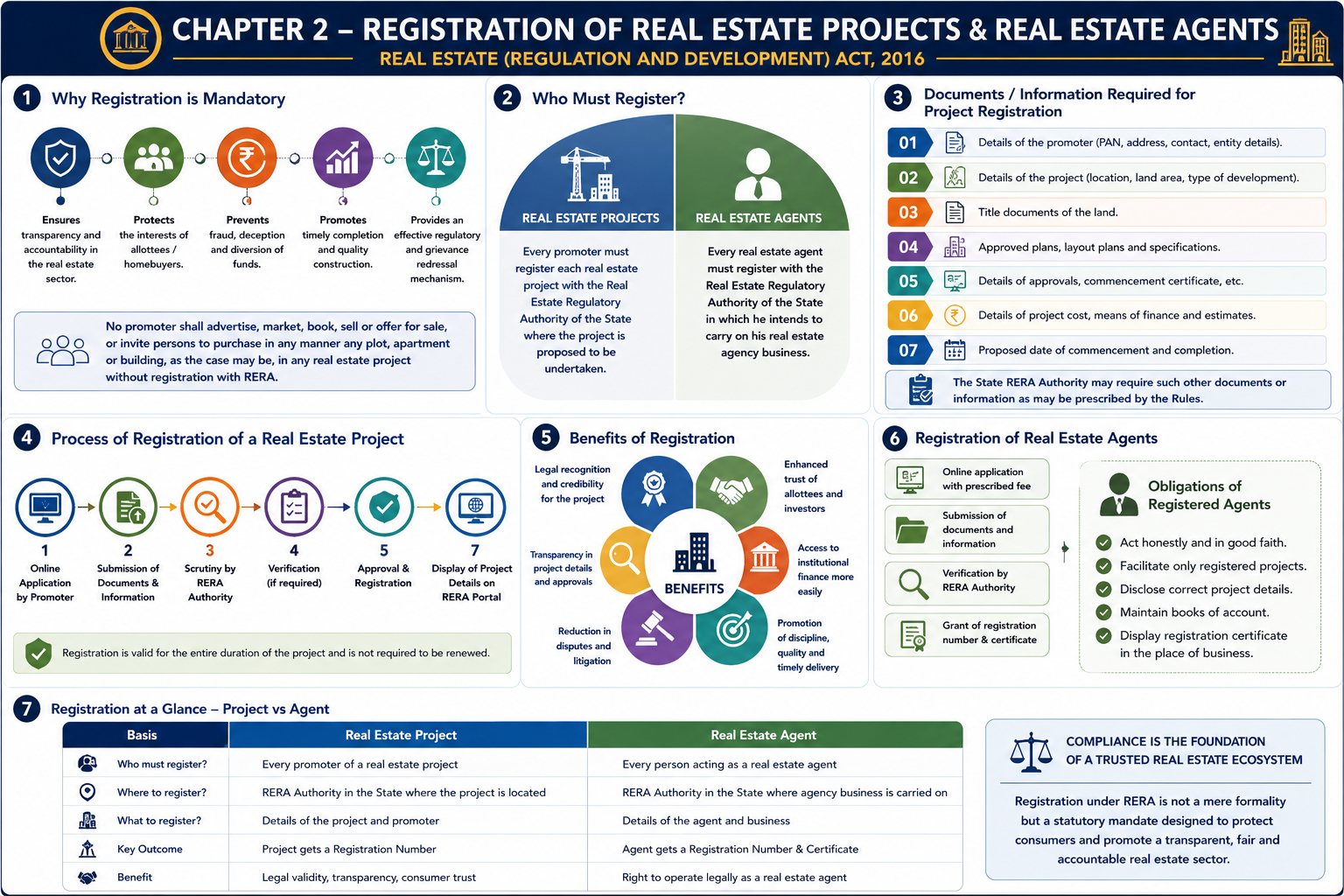
Registration is the cornerstone of the Real Estate (Regulation and Development) Act, 2016. Under Section 3, every promoter intending to advertise, market, book, sell or offer for sale any apartment, plot or building in a real estate project covered by the Act must first obtain registration from the concerned Real Estate Regulatory Authority (RERA). Registration promotes transparency, financial discipline and public confidence while enabling homebuyers to verify project details before investing.
Why Registration is Important
Registration ensures that the promoter makes statutory disclosures regarding approvals, land title, project schedule, carpet area, financial arrangements and construction progress. It also enables continuous monitoring by the Regulatory Authority and provides greater protection to homebuyers.
Projects Requiring Registration
| Type of Project | Requirement |
|---|---|
| Residential Projects | Registration is mandatory if the project falls within the scope of Section 3. |
| Commercial Projects | Registration is mandatory where the statutory criteria are satisfied. |
| Mixed-use Projects | Registration is compulsory. |
| Ongoing Projects | Projects without a Completion Certificate on commencement of the Act generally require registration, subject to State Rules. |
Projects Exempt from Registration
| Exemption | Relevant Provision |
|---|---|
| Land area not exceeding 500 sq. metres* | Section 3(2) |
| Projects not exceeding eight apartments* | Section 3(2) |
| Projects completed before commencement of the Act | Section 3(2) |
| Renovation, repair or redevelopment without fresh marketing or sale | Section 3(2) |
*Subject to amendments made by the appropriate Government through Rules or notifications.
Registration Process
The registration process broadly involves the following stages:
Step 1
Preparation of statutory documents.
Step 2
Online submission of application before the State RERA.
Step 3
Scrutiny of documents by the Authority.
Step 4
Grant or rejection of registration.
Step 5
Publication of project details on the RERA portal.
Step 6
Periodic compliance and quarterly updates.
Documents Required for Registration
A promoter seeking registration of a real estate project is required to furnish complete and accurate information before the Regulatory Authority. The objective is to ensure transparency regarding ownership, approvals, financial capability and the proposed development.
| Category | Documents Commonly Required |
|---|---|
| Promoter Details | Name, address, PAN, constitution documents, registration certificates and previous project details. |
| Land Documents | Title deeds, ownership documents, encumbrance certificate and details of legal rights over the land. |
| Project Approvals | Sanctioned plans, layout plans, building approvals, commencement certificate and other statutory permissions. |
| Financial Information | Estimated project cost, funding arrangements and details of the separate RERA bank account. |
| Project Schedule | Proposed completion timeline, development schedule and phase-wise implementation, where applicable. |
| Statutory Declaration | Declaration under Section 4 regarding legal title, encumbrances, timely completion and deposit of seventy per cent of project collections in the designated bank account. |
Practice Note
Incomplete applications or inaccurate disclosures frequently result in delays, additional queries from the Regulatory Authority or rejection of the application. Advocates should verify all title documents, approvals and statutory declarations before submission.
Registration of Real Estate Agents
Sections 9 and 10 of RERA require every real estate agent facilitating the sale or purchase of apartments, plots or buildings in registered real estate projects to obtain registration from the concerned State RERA. An unregistered agent cannot lawfully facilitate transactions in projects requiring registration under the Act.
| Requirement | Details |
|---|---|
| Registration | Mandatory before facilitating sale or purchase in registered projects. |
| Validity | Valid for the period prescribed under the applicable State Rules and renewable thereafter. |
| Records | Maintain proper books, records and documents relating to transactions. |
| Compliance | Avoid unfair trade practices and comply with directions issued by RERA. |
Revocation of Registration
The Regulatory Authority may revoke the registration of a project or a real estate agent for violation of the provisions of the Act, Rules or Regulations, breach of registration conditions, unfair trade practices or persistent non-compliance with statutory directions. Upon revocation, the Authority may issue appropriate directions to safeguard the interests of allottees.
Consequences of Non-Registration
| Default | Possible Consequence |
|---|---|
| Marketing or sale without registration | Penalty and regulatory action under RERA. |
| False disclosures | Penalty, compensation and possible revocation. |
| Violation of registration conditions | Suspension or revocation of registration. |
| Failure to comply with RERA orders | Further penalties and enforcement proceedings. |
Bihar RERA and West Bengal (HIRA)
State Practice Note
Most States, including Bihar and West Bengal, have established Real Estate Regulatory Authorities under the Real Estate (Regulation and Development) Act, 2016 (RERA). While the Central Act applies throughout the country, each State has framed its own Rules and administrative procedures. Advocates should therefore verify the applicable State Rules, notifications, circulars, procedural requirements and the latest orders of the respective State RERA before advising clients or initiating proceedings.
Practical Checklist for Advocates
✓ Verify
Project registration number and current status.
✓ Examine
Title documents, approvals and sanctioned plans.
✓ Confirm
Separate bank account and statutory disclosures.
✓ Review
Orders, complaints and litigation pending before RERA.
Relevant Provisions
| Provision | Subject |
|---|---|
| Section 3 | Registration of Real Estate Projects. |
| Section 4 | Application for Registration. |
| Sections 5–8 | Grant, Extension and Revocation of Registration. |
| Sections 9–10 | Registration and Duties of Real Estate Agents. |
AVP Practice Tip
Before instituting or defending any proceeding under RERA, obtain a complete download of the project details from the State RERA portal. The registration particulars, disclosures, approvals and quarterly updates frequently become the most valuable documentary evidence during litigation.
Key Takeaways
- Registration under Section 3 is the foundation of RERA compliance.
- Registration promotes transparency and protects homebuyers.
- Real estate agents must also obtain registration before facilitating transactions.
- Failure to register may result in penalties, revocation and regulatory action.
- Always verify State-specific Rules before advising clients.
Further Reading
For important judicial decisions on project registration, registration of real estate agents and related compliance issues, refer to the RERA Landmark Case Law Compendium. Frequently asked practical questions are covered in the separate RERA FAQ Handbook.
Professional Disclaimer
This Guide has been prepared by AVP Legis Chambers for general educational and informational purposes only. While every effort has been made to ensure the accuracy of the information contained herein, the law relating to real estate regulation is continuously evolving through legislative amendments, State Rules, notifications, circulars and judicial pronouncements.
The contents of this Guide are intended to provide a practical overview of the Real Estate (Regulation and Development) Act, 2016 (RERA) and should not be construed as legal advice, legal opinion or a substitute for professional consultation. The applicability of RERA depends upon the facts of each case, the relevant State Rules and the latest judicial precedents.
Readers should obtain independent legal advice before making any investment decision, initiating or defending proceedings before a Real Estate Regulatory Authority, Adjudicating Officer, Real Estate Appellate Tribunal or any Court, or acting upon the information contained in this Guide.
References to statutory provisions, regulatory authorities, judicial decisions and procedural requirements are intended only for general guidance and may undergo modification with changes in law or interpretation by competent courts and authorities.
Neither AVP Legis Chambers nor the authors of this Guide accept any responsibility or liability for any loss, claim or consequence arising from reliance upon the information contained herein without obtaining appropriate professional advice.