x

INTEGRITY

│
Advocates
•
Solicitors
•
Mediators
•
Chartered Accountants
•
Insolvency Professionals
Advocates & Solicitors

Chapter 1 – Introduction to the Real Estate (Regulation and Development) Act, 2016
The Real Estate (Regulation and Development) Act, 2016 (RERA) is India's first comprehensive legislation enacted to regulate the real estate sector, promote transparency, ensure accountability and protect the interests of homebuyers. The Act mandates registration of eligible real estate projects and real estate agents, regulates utilisation of project funds, prescribes disclosure obligations and establishes specialised authorities for speedy adjudication of disputes.
RERA seeks to balance the interests of promoters, allottees, financial institutions and other stakeholders while encouraging responsible and sustainable growth of the real estate sector.
Practice Note
RERA is not merely a consumer protection legislation. It is a comprehensive regulatory framework intended to improve governance, transparency and financial discipline within the real estate industry.
Why was RERA Enacted?
- Delay in possession of projects.
- Diversion of homebuyers' funds.
- Misleading advertisements.
- Frequent changes in sanctioned plans.
- Lack of transparency.
- Poor construction quality.
- Absence of a specialised regulator.
- Lengthy litigation before multiple forums.
The Act was enacted to restore consumer confidence and establish a transparent and accountable regulatory framework.
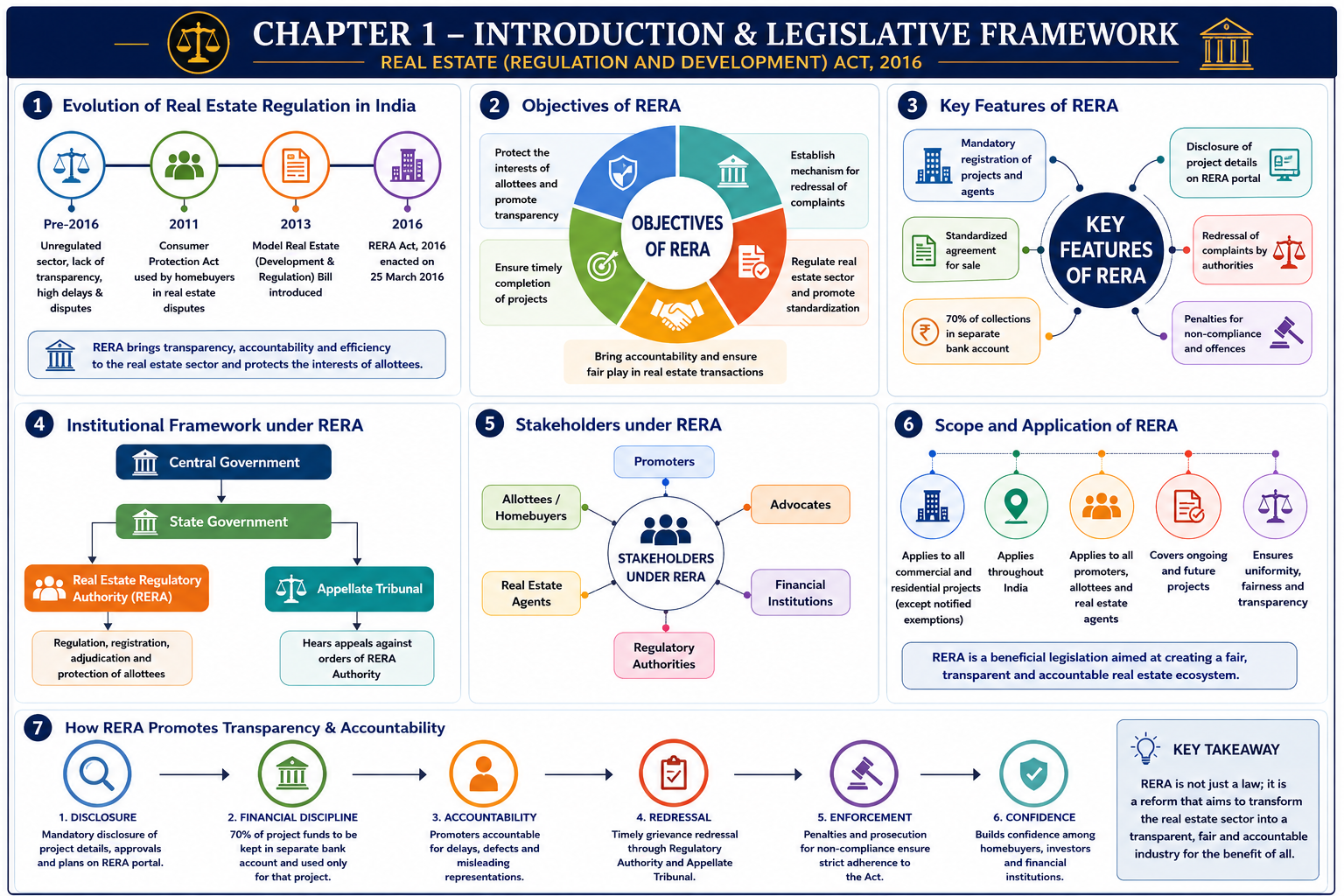
Objectives of RERA
01
Consumer Protection
Safeguard the interests of homebuyers.
02
Transparency
Ensure disclosure of project information.
03
Timely Completion
Reduce delays in project delivery.
04
Accountability
Fix responsibility upon promoters and agents.
05
Dispute Resolution
Provide specialised adjudicatory mechanisms.
06
Sectoral Growth
Promote investment and professionalism.
Salient Features of RERA
| Feature | Purpose |
|---|---|
| Project Registration | Prevents unauthorised launches. |
| Agent Registration | Ensures accountability. |
| Separate Bank Account | Prevents diversion of funds. |
| Carpet Area Standardisation | Uniform pricing. |
| Mandatory Disclosures | Greater transparency. |
| Interest & Compensation | Protects allottees. |
| Regulatory Authority | Monitoring and enforcement. |
| Appellate Tribunal | Speedy appeals. |
Institutional Framework
Real Estate Regulatory Authority
Registers projects and agents, monitors compliance and protects consumer interests.
Adjudicating Officer
Determines compensation claims under the Act.
Real Estate Appellate Tribunal
Hears appeals against orders passed under RERA.
Important Definitions
| Term | Meaning |
|---|---|
| Promoter | Developer responsible for the project. |
| Allottee | Purchaser of a plot, apartment or building. |
| Real Estate Agent | Person facilitating sale or purchase of property. |
| Carpet Area | Net usable floor area as defined under the Act. |
| Completion Certificate | Certificate confirming lawful completion. |
Benefits of RERA
Homebuyers
- Transparency
- Timely possession
- Compensation
- Speedy remedies
Developers
- Market credibility
- Investor confidence
- Uniform regulation
Financial Institutions
- Improved due diligence
- Reduced lending risks
- Better project monitoring
Advocate's Tip
Before accepting a matter, verify whether the project is registered under the applicable State RERA, examine the registration details, approvals, project completion timeline and any pending complaints available on the State RERA portal.
Key Takeaways
- RERA is India's principal legislation regulating the real estate sector.
- Consumer protection and transparency are its primary objectives.
- Project registration and financial discipline form the backbone of the Act.
- Dedicated authorities provide specialised dispute resolution.
- The Act operates alongside other property and commercial laws.
Applicability of RERA
RERA applies to residential, commercial and mixed-use real estate projects that satisfy the registration requirements prescribed under the Act. Subject to statutory exemptions, every promoter intending to advertise, market, book or sell apartments, plots or buildings must obtain registration from the concerned State Real Estate Regulatory Authority before commencing such activities.
The Act also regulates the functioning of real estate agents and provides a specialised framework for registration, disclosures, dispute resolution and enforcement.
Relevant Statutory Provisions
| Provision | Subject |
|---|---|
| Section 2 | Definitions |
| Sections 3–10 | Registration of Projects |
| Sections 9–10 | Registration of Real Estate Agents |
| Sections 11–18 | Duties of Promoters and Rights of Allottees |
| Sections 20–39 | Real Estate Regulatory Authority |
| Sections 40–58 | Appeals, Enforcement and Penalties |
AVP Practice Tip
Before advising a client, always verify the project's registration status on the State RERA portal, examine approvals, completion timelines and previous regulatory orders. Early due diligence often prevents avoidable litigation.
Further Reading
For landmark judgments relating to this chapter, refer to the RERA Landmark Case Law Compendium. Practical questions on these topics are covered in the separate RERA FAQ Handbook.
Professional Disclaimer
This Guide has been prepared by AVP Legis Chambers for general educational and informational purposes only. While every effort has been made to ensure the accuracy of the information contained herein, the law relating to real estate regulation is continuously evolving through legislative amendments, State Rules, notifications, circulars and judicial pronouncements.
The contents of this Guide are intended to provide a practical overview of the Real Estate (Regulation and Development) Act, 2016 (RERA) and should not be construed as legal advice, legal opinion or a substitute for professional consultation. The applicability of RERA depends upon the facts of each case, the relevant State Rules and the latest judicial precedents.
Readers should obtain independent legal advice before making any investment decision, initiating or defending proceedings before a Real Estate Regulatory Authority, Adjudicating Officer, Real Estate Appellate Tribunal or any Court, or acting upon the information contained in this Guide.
References to statutory provisions, regulatory authorities, judicial decisions and procedural requirements are intended only for general guidance and may undergo modification with changes in law or interpretation by competent courts and authorities.
Neither AVP Legis Chambers nor the authors of this Guide accept any responsibility or liability for any loss, claim or consequence arising from reliance upon the information contained herein without obtaining appropriate professional advice.