x

INTEGRITY
│
Advocates
•
Solicitors
•
Mediators
•
Chartered Accountants
•
Insolvency Professionals
Advocates & Solicitors

Chapter 7 – Complaints, Adjudication & Appeals
Introduction
One of the most significant reforms introduced by the Real Estate (Regulation and Development) Act, 2016 ("RERA") is the establishment of a specialised dispute resolution mechanism for the real estate sector. Prior to RERA, aggrieved homebuyers were largely dependent upon civil courts or consumer fora for enforcement of contractual rights. Litigation was often prolonged, expensive and procedurally complex, resulting in considerable hardship for purchasers and uncertainty for developers.
RERA addresses these concerns by creating a dedicated adjudicatory framework comprising the Real Estate Regulatory Authority ("Authority"), the Adjudicating Officer and the Real Estate Appellate Tribunal. Each of these authorities exercises distinct statutory powers. While the Regulatory Authority primarily deals with regulatory compliance, project registration, promoter obligations and enforcement of the provisions of the Act, claims relating to compensation under Sections 12, 14, 18 and 19 are adjudicated by the Adjudicating Officer appointed under Section 71. Appeals against the decisions of the Authority or the Adjudicating Officer lie before the Real Estate Appellate Tribunal and, thereafter, on questions of law, before the jurisdictional High Court.
The availability of specialised forums has significantly strengthened consumer protection by providing an efficient, transparent and sector-specific mechanism for adjudication of disputes. The remedies under RERA are generally in addition to other remedies available under law, thereby enabling an allottee, promoter or real estate agent to pursue appropriate legal remedies depending upon the facts and circumstances of each case.
This chapter explains the jurisdiction of the Regulatory Authority, the powers of the Adjudicating Officer, the procedure for filing complaints, appeals before the Appellate Tribunal, and the practical considerations that advocates, developers and homebuyers should bear in mind while pursuing proceedings under the Act.
Statutory Framework
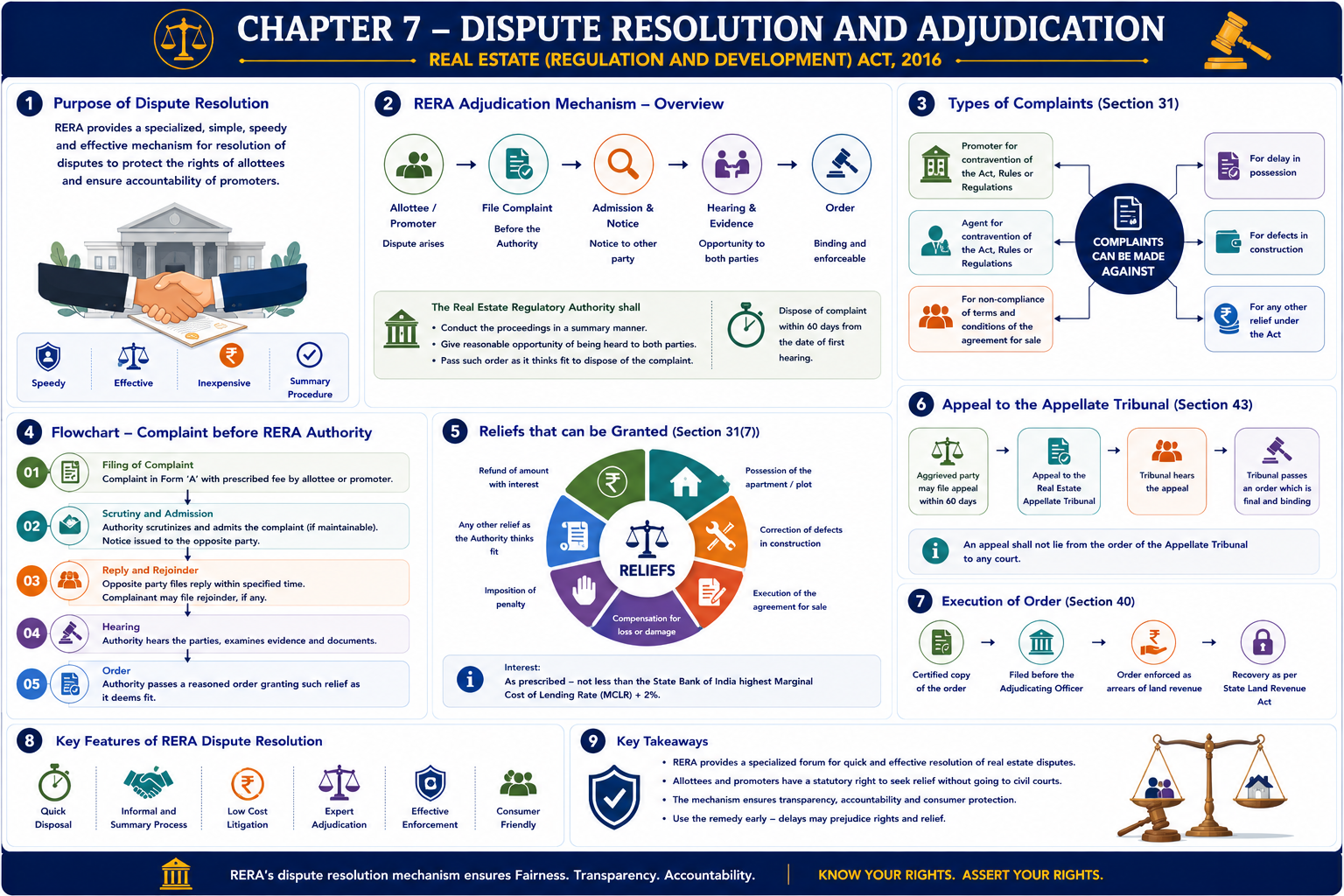
The dispute resolution mechanism under RERA is principally governed by the following statutory provisions:
| Provision | Subject Matter |
|---|---|
| Section 31 | Who may file a complaint before the Regulatory Authority or the Adjudicating Officer. |
| Section 35 | Powers of the Regulatory Authority to call for information and conduct inquiries. |
| Section 36 | Power to grant interim orders. |
| Section 37 | Power to issue directions for compliance with the Act. |
| Section 38 | Powers and responsibilities of the Regulatory Authority. |
| Section 43 | Establishment of the Real Estate Appellate Tribunal. |
| Section 44 | Appeals before the Appellate Tribunal. |
| Section 58 | Appeal to the High Court on substantial questions of law. |
| Section 71 | Appointment and jurisdiction of the Adjudicating Officer. |
Practice Note
Before initiating proceedings, the complainant should identify the correct forum. Matters involving project registration, promoter obligations, regulatory violations and compliance generally fall within the jurisdiction of the Regulatory Authority, whereas claims for compensation under Sections 12, 14, 18 and 19 are ordinarily adjudicated by the Adjudicating Officer. Choosing the appropriate forum at the outset avoids unnecessary procedural objections and delays.
Before initiating proceedings, the complainant should identify the correct forum. Matters involving project registration, promoter obligations, regulatory violations and compliance generally fall within the jurisdiction of the Regulatory Authority, whereas claims for compensation under Sections 12, 14, 18 and 19 are ordinarily adjudicated by the Adjudicating Officer. Choosing the appropriate forum at the outset avoids unnecessary procedural objections and delays.
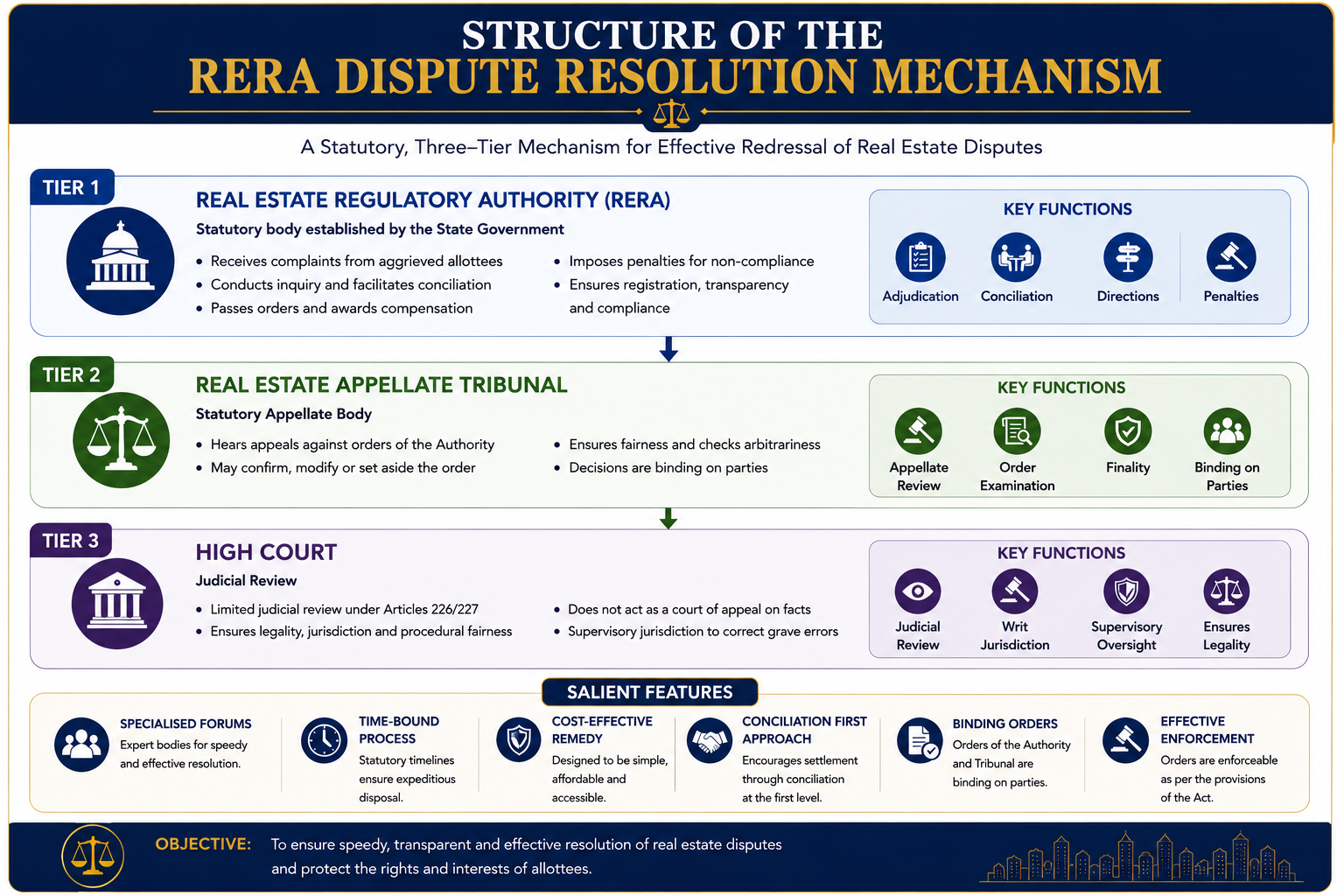
Structure of the RERA Dispute Resolution Mechanism
Key Principle
The Regulatory Authority, the Adjudicating Officer and the Appellate Tribunal perform different statutory functions. Identifying the correct forum is often the first and most important strategic decision in every RERA dispute.
The Regulatory Authority, the Adjudicating Officer and the Appellate Tribunal perform different statutory functions. Identifying the correct forum is often the first and most important strategic decision in every RERA dispute.
Who May File a Complaint – Section 31
Section 31 of the Real Estate (Regulation and Development) Act, 2016 confers a broad right to institute proceedings before the Regulatory Authority or the Adjudicating Officer. The provision is intended to ensure that every stakeholder affected by a violation of the Act has access to an effective statutory remedy. Unlike traditional civil litigation, proceedings under RERA are designed to provide a specialised, efficient and sector-specific mechanism for resolution of disputes arising from real estate projects.
A complaint may be filed not only by an allottee but also by promoters, real estate agents and recognised associations of allottees. The appropriate forum depends upon the nature of the relief sought and the statutory provision invoked.
| Person Entitled to File | Illustrative Nature of Complaint |
|---|---|
| Allottee | Delay in possession, refund, interest, misleading advertisements, defects in construction, breach of Agreement for Sale and other violations of RERA. |
| Promoter | Disputes arising from defaults committed by allottees, including non-payment of instalments or breach of contractual obligations. |
| Real Estate Agent | Matters affecting registration, compliance obligations or disputes arising under the Act. |
| Association of Allottees | Complaints concerning common areas, project completion, maintenance obligations or violations affecting multiple purchasers. |
Who May Be Made a Respondent?
The respondent will ordinarily depend upon the nature of the grievance. In most homebuyer disputes, the promoter is the principal respondent. However, the Act also permits proceedings against registered real estate agents and, in appropriate circumstances, against allottees where statutory or contractual obligations have been violated.
| Respondent | Typical Circumstances |
|---|---|
| Promoter | Delay in possession, non-disclosure, alteration of plans, refund claims, structural defects and non-compliance with statutory obligations. |
| Real Estate Agent | Misrepresentation, false advertisements or violations of obligations imposed under RERA. |
| Allottee | Persistent default in payment or breach of obligations under the Agreement for Sale, where relief is sought by the promoter. |
Jurisdiction of the Regulatory Authority and the Adjudicating Officer
One of the most important practical issues under RERA is identifying the correct forum. Although both authorities function under the Act, their jurisdiction is distinct. Filing proceedings before an inappropriate forum may lead to avoidable procedural delays.
| Regulatory Authority | Adjudicating Officer |
|---|---|
| Registration of projects and agents. | Compensation under Sections 12, 14, 18 and 19. |
| Regulatory compliance. | Assessment of compensation payable. |
| Directions to promoters or agents. | Adjudication of compensation claims. |
| Interim orders and regulatory enforcement. | Determination of monetary liability under the Act. |
Practical Tip
Before drafting a complaint, identify the precise statutory relief sought. Where the dispute principally concerns compensation under Sections 12, 14, 18 or 19, proceedings should ordinarily be instituted before the Adjudicating Officer. Matters involving registration, compliance, regulatory directions or enforcement generally fall within the jurisdiction of the Regulatory Authority.
Before drafting a complaint, identify the precise statutory relief sought. Where the dispute principally concerns compensation under Sections 12, 14, 18 or 19, proceedings should ordinarily be instituted before the Adjudicating Officer. Matters involving registration, compliance, regulatory directions or enforcement generally fall within the jurisdiction of the Regulatory Authority.
Checklist Before Filing a Complaint
| ✓ | Verify that the project is registered under the applicable State RERA. |
| ✓ | Collect the Agreement for Sale, allotment letter, payment receipts and correspondence. |
| ✓ | Download project disclosures from the State RERA portal. |
| ✓ | Identify the correct respondent and the appropriate statutory forum. |
| ✓ | Clearly quantify the relief claimed, including refund, interest or compensation where applicable. |
| ✓ | Ensure that the prescribed complaint form and fee under the applicable State Rules are complied with. |
Procedure After Filing a Complaint
After a complaint is instituted before the Regulatory Authority or the Adjudicating Officer, notice is ordinarily issued to the respondent, requiring the filing of a reply within the prescribed period. The proceedings are intended to be summary in nature, with emphasis on expeditious adjudication while ensuring compliance with the principles of natural justice. Both parties are afforded a reasonable opportunity to present documentary evidence, affidavits and oral submissions before the matter is finally decided.
The Regulatory Authority possesses wide powers to conduct inquiries, call for information, examine records, issue directions and enforce compliance with the provisions of the Act. Proceedings are generally less formal than ordinary civil litigation, thereby enabling disputes to be resolved more efficiently while maintaining procedural fairness.
Powers of the Regulatory Authority
| Power | Purpose |
|---|---|
| Call for Information | Require promoters, agents or allottees to produce records and documents. |
| Conduct Inquiry | Investigate violations of the Act or the Rules. |
| Issue Directions | Direct compliance with statutory obligations and project requirements. |
| Grant Interim Relief | Pass temporary orders to protect the interests of parties during pendency of proceedings. |
| Impose Penalties | Recommend or initiate action where statutory defaults are established. |
Appeals before the Real Estate Appellate Tribunal
Any person aggrieved by an order of the Regulatory Authority or the Adjudicating Officer may prefer an appeal before the Real Estate Appellate Tribunal established under Section 43 of the Act. The appeal must ordinarily be filed within the limitation period prescribed by Section 44, accompanied by the prescribed fee and supporting documents. The Tribunal possesses powers to confirm, modify or set aside the impugned order after hearing the parties.
The Appellate Tribunal functions as the principal appellate forum under RERA and is expected to decide appeals expeditiously, having regard to the objectives of the legislation.
Appeal to the High Court
Section 58 provides a further statutory remedy by permitting an appeal to the jurisdictional High Court against the decision of the Appellate Tribunal. However, such appeal is confined to substantial questions of law and does not ordinarily involve re-appreciation of factual findings recorded by the Tribunal.
Litigation Strategy
Before filing an appeal, carefully analyse whether the grievance involves factual appreciation or a substantial question of law. Appeals to the High Court should ordinarily focus upon errors of legal interpretation, jurisdictional issues or violations of statutory provisions rather than mere disagreement with findings of fact.
Before filing an appeal, carefully analyse whether the grievance involves factual appreciation or a substantial question of law. Appeals to the High Court should ordinarily focus upon errors of legal interpretation, jurisdictional issues or violations of statutory provisions rather than mere disagreement with findings of fact.
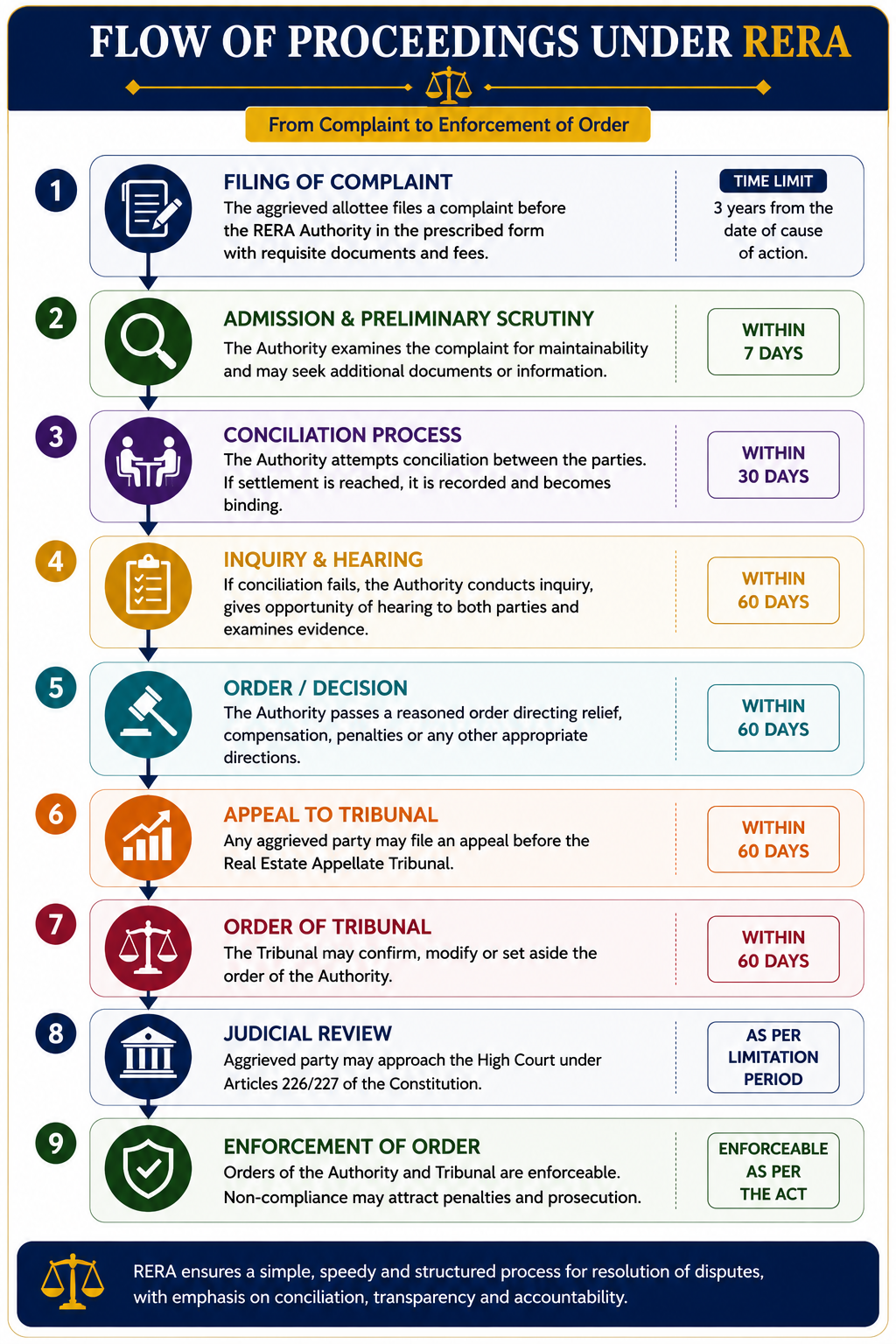
Flow of Proceedings under RERA
Key Takeaways
- RERA establishes specialised forums for speedy adjudication of real estate disputes.
- The Regulatory Authority and the Adjudicating Officer exercise distinct statutory jurisdictions.
- Choosing the appropriate forum is often decisive for the effective prosecution of a complaint.
- The Appellate Tribunal serves as the primary appellate forum under the Act.
- An appeal to the High Court is confined to substantial questions of law.
- Comprehensive documentation and careful pleading substantially improve the prospects of obtaining effective relief.
Further Reading
- Chapter 5 – Agreement for Sale, Possession & Conveyance
- Chapter 6 – Financial Discipline & Project Compliance
- Chapter 8 – Offences, Penalties & Enforcement
- Relevant State RERA Rules governing complaint procedures and prescribed forms.
Professional Note
Although RERA prescribes a specialised dispute resolution mechanism, practitioners should always examine whether concurrent remedies under the Consumer Protection Act, arbitration agreements (where legally permissible), constitutional remedies or other statutory forums may also be available depending upon the facts of the case. A carefully planned litigation strategy often requires evaluating all available remedies before initiating proceedings.
Although RERA prescribes a specialised dispute resolution mechanism, practitioners should always examine whether concurrent remedies under the Consumer Protection Act, arbitration agreements (where legally permissible), constitutional remedies or other statutory forums may also be available depending upon the facts of the case. A carefully planned litigation strategy often requires evaluating all available remedies before initiating proceedings.
Professional Disclaimer
This Guide has been prepared by AVP Legis Chambers for general educational and informational purposes only. While every effort has been made to ensure the accuracy of the information contained herein, the law relating to real estate regulation is continuously evolving through legislative amendments, State Rules, notifications, circulars and judicial pronouncements.
The contents of this Guide are intended to provide a practical overview of the Real Estate (Regulation and Development) Act, 2016 (RERA) and should not be construed as legal advice, legal opinion or a substitute for professional consultation. The applicability of RERA depends upon the facts of each case, the relevant State Rules and the latest judicial precedents.
Readers should obtain independent legal advice before making any investment decision, initiating or defending proceedings before a Real Estate Regulatory Authority, Adjudicating Officer, Real Estate Appellate Tribunal or any Court, or acting upon the information contained in this Guide.
References to statutory provisions, regulatory authorities, judicial decisions and procedural requirements are intended only for general guidance and may undergo modification with changes in law or interpretation by competent courts and authorities.
Neither AVP Legis Chambers nor the authors of this Guide accept any responsibility or liability for any loss, claim or consequence arising from reliance upon the information contained herein without obtaining appropriate professional advice.